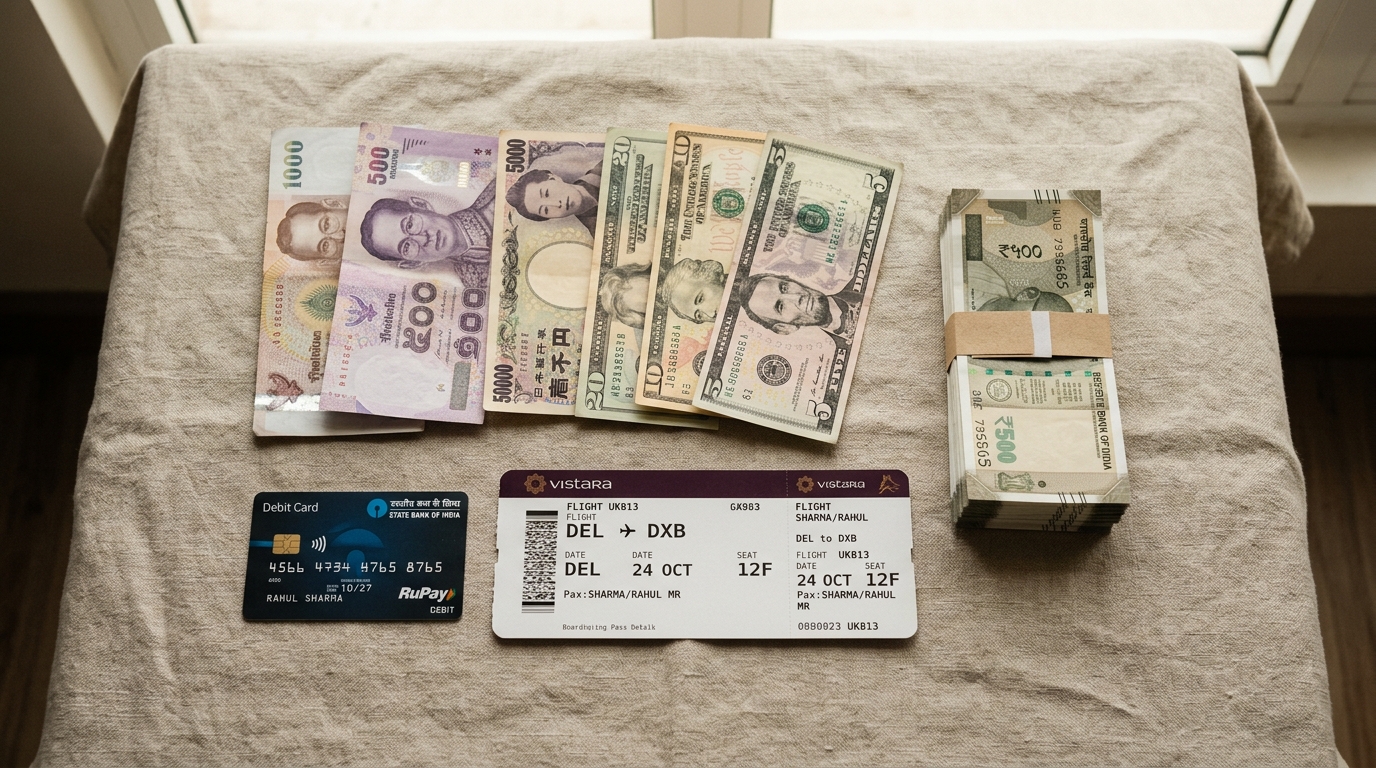
Cash vs. Card in Southeast Asia: Real Spending & Safety
Most travel blogs insist you can "live on card alone" in Southeast Asia. The reality for Indian travelers is messier: card declines happen in Vietnam, ATM skimming is real in Cambodia, and a 30,000 INR street market in Thailand won't take Visa. You need a hybrid strategy that works with how Southeast Asia actually operates—not how guidebooks wish it worked.
1. Card Rejection Rates by Country & Where They Matter
Cards fail in Southeast Asia far more often than in Europe. Your Visa or Mastercard will work at major hotels and malls, but the failure rate jumps dramatically once you leave tourist zones.
Thailand sees card rejection in ~40% of small vendors—food stalls, tuk-tuk drivers, and mid-range restaurants routinely demand cash. Vietnam is worse: rural areas and smaller towns reject cards outright. Cambodia's ATM network is unreliable; you'll get declined at the till in Siem Reap markets. Laos and Myanmar are almost entirely cash economies.
Where cards do work reliably:
- Bangkok's BTS-area restaurants, Central World, Emporium
- Ho Chi Minh City District 1 (touristy zones)
- Phnom Penh's Tuol Tompuong and Riverside
- Kuala Lumpur shopping malls
- Hanoi's Old Quarter tourist shops (though failure still common)
The rule: cards work in cities, cash rules outside them. Since you'll inevitably leave the hotel district, plan accordingly.
| Country | ATM Availability | Card Acceptance | Card Decline Rate | Recommendation |
|---|---|---|---|---|
| Thailand | Excellent (7-Eleven everywhere) | Good in malls/hotels | 15–20% | 40% cash, 60% card |
| Vietnam | Good in cities, rare rural | Poor outside District 1 | 35–40% | 50% cash, 50% card |
| Cambodia | Patchy, some scams reported | Poor except malls | 45–50% | 60% cash, 40% card |
| Laos | Sparse | Minimal | 80%+ | 80% cash, 20% card |
| Myanmar | Very limited | Rare | 95%+ | 90% cash, 10% card |
2. ATM Safety: Real Scams & How to Avoid Them
ATM fraud in Southeast Asia isn't an urban legend. Card skimming is documented regularly, especially at standalone machines in malls, bars, and touristy areas. The risk isn't the ATM operator (usually legitimate)—it's third-party criminals installing hidden card readers and cameras.
Common scam patterns:
- Loose or bulging card slot (sign of skimmer hardware)
- ATM in a dark corner with no visible CCTV
- Machine outside a closed bank (unmanned overnight)
- Loose pinpad or wobbling keyboard
- ATM in a bar or nightclub (lower monitoring)
The scam works like this: your card is cloned, and within 24 hours, fraudsters in Thailand or Vietnam max it out. Your Indian bank catches it eventually, but you're card-less on day 8 of a 14-day trip.
How to protect yourself:
- Use only ATMs inside banks or their official lobbies (Bangkok Bank, Vietcombank, Maybank lobbies are safe).
- Withdraw larger amounts less often (safer than six small withdrawals). One ₹50,000 withdrawal beats six ₹8,000 hits.
- Use Visa debit cards with PIN + OTP (one-time password) over credit cards (OTP adds a layer of fraud protection).
- Check your account daily via your Indian bank's app—catch cloning within 12 hours, not 12 days.
- Carry a separate card (backup) in a different bag, sealed and unused until needed.
- Block contactless payments before you travel (settings in your bank app or call your bank). Contactless is vulnerable to relay attacks.
Never use an ATM that looks tampered with. It's not worth saving ₹500 on an overcharge to risk ₹50,000 in fraud.
3. Optimal Cash Carry for a 2-Week Trip
The math: 14 days in Southeast Asia costs ₹35,000–₹55,000 for a mid-range Indian traveler (flights excluded). Breaking it down by currency and withdrawal schedule prevents both running dry and carrying unsafe amounts.
Daily spending by category:
- Accommodation: ₹1,500–₹2,500 (₹21,000–₹35,000 for 14 nights)
- Food (mix of street & restaurants): ₹600–₹1,200
- Activities, transport, miscellaneous: ₹500–₹1,000
- Total daily: ₹2,600–₹4,700
For a ₹40,000 budget over 14 days, you need roughly ₹2,900 daily. Here's the cash-carry breakdown:
Withdrawal strategy:
- Day 1 (arrival in Bangkok or first city): Withdraw 10,000 THB (₹20,000) at airport ATM or exchange counter. Bank ATMs at airport are safest; skip airport money changers (poor rates).
- Day 4–5: Withdraw 500,000 VND (₹17,000) in Vietnam. Stick to Vietcombank ATMs in Hanoi or HCMC.
- Day 10: Withdraw 8 million KIP (₹10,000) in Laos if needed, or carry Thai baht instead (baht accepted everywhere in Laos).
- Reserve: Keep ₹2,000 USD or ₹1,000 notes as a last-resort backup in your room safe.
| Leg | Duration | Currency | Optimal Cash | When to Withdraw |
|---|---|---|---|---|
| Thailand | Days 1–5 | THB | 10,000–12,000 | Day 1, airport |
| Vietnam | Days 5–10 | VND | 500,000–700,000 | Day 5, Hanoi/HCMC |
| Cambodia/Laos | Days 10–14 | USD or THB | $100 or 3,000 THB | Day 10 |
Why this works: You're not carrying more than ₹20,000 in any one currency at once. Each withdrawal is at a bank ATM, limiting fraud exposure. You refresh your cash supply as you move countries, so you're not stuffing a money belt with ₹40,000 on day 1.
Use your Trip budget calculator to refine these numbers based on your actual accommodation splurges or activity plans.
4. Card Types: Which to Bring (and Which to Avoid)
Not all Indian debit cards are equal in Southeast Asia. Some banks have limited international networks; others charge 2.5% on every transaction.
Best card choices:
- HDFC Smartbuy or ForexPlus debit card: Zero forex markup on international transactions (actually 1% cheaper than standard HDFC). Widely accepted across Asia.
- ICICI Coral or Rubyx credit card: Zero forex markup. Requires you to pay off balance monthly, but works well for malls and restaurants.
- Axis Vistara or Burgundy: 1% forex markup (low by Indian standards). Strong acceptance in SE Asia.
- SBI Global or iCicibank travel card: Preloaded forex card. Fixed rate locked in India (no ATM shock). Useful as backup, though less flexible.
Cards to avoid:
- Standard SBI or PNB debit cards: 2–3% forex markup kills your budget. Withdrawal fees add another 1–2%.
- Kotak Mahindra or Axis basic debit cards: Forex markup + high ATM fees. Not designed for travel.
- Credit cards with annual forex of 2.5%+: You're losing ₹1,000 per ₹40,000 spent.
Pro setup: Dual-card system
Bring two cards from different banks. This isn't paranoia—it's protection. If your HDFC card gets cloned (or you drop it), your ICICI card keeps you solvent. When one card declines inexplicably, you have a backup. Your bank can block your card within 2 hours of a reported fraud, leaving you stranded if it's your only card.
Use your Forex & bargain check to compare the exact forex rates you'll pay with each card before departure.
5. Split Payment Strategy: When to Use Card, When Cash
The real risk isn't choosing card or cash in isolation—it's using the wrong one at the wrong place.
Use cash for:
- Street food, local restaurants, wet markets (anything under ₹500)
- Tuk-tuks, local transport, motorcabs
- Bargaining at markets (shopkeepers discount for cash to avoid card fees)
- Temples, local guides, tips
- Small guesthouses under ₹2,000/night
Use card for:
- Hotels and major resorts (use card records for expense claims)
- Flight bookings, tours booked via Klook or Viator (covered by chargeback if fraud occurs)
- Malls, restaurants with AC, international chains
- Train and bus tickets (Grab, 12go, MuBus)
- Anything over ₹2,000 where you want a receipt
The hybrid tap system:
- Carry 20,000 THB in cash (mixed denominations: 500s, 100s, 50s).
- Keep a debit card in your main wallet.
- Reserve a backup card in your hostel locker or hotel safe.
- Use Grab (Southeast Asia's Uber) with your card—it's protected by terms of service and dispute resolution.
This split prevents the "all cash = mugging risk" and "all card = stranded if declined" scenarios equally.
6. Security Habits That Actually Reduce Risk
Carrying cash and cards in Southeast Asia isn't inherently dangerous. Sloppy habits are. Theft from tourists is rare, but pickpocketing in Bangkok's BTS and Hanoi's Old Quarter is common.
Money separation strategy:
- Wallet (for immediate spending): Daily cash (2,000–3,000 THB) + one card only.
- Money belt (worn under shirt): Reserve cash (10,000 THB equivalent) + backup card.
- Hotel safe: ₹2,000 notes or USD backup + copies of passport + return flight details.
Daily habits:
- Never display cash in public. Count money in your room or private bathroom.
- Use ATMs during daylight and in busy areas (7-Eleven ATMs are usually safe; bank lobbies are safest).
- Check your bag every 30 minutes in crowded spaces (BTS trains in Bangkok, Ben Thanh market in HCMC).
- Share your card details with no one, even restaurant staff offering to "process it inside" (Grab does this digitally; old-school restaurants do not).
- Use the Survival phrasebook to ask taxi drivers "Is there a fee?" (Uber/Grab have transparent pricing; taxis don't).
What insurance doesn't cover:
- Cash theft (no reimbursement; it's gone).
- ATM fraud if you used a tampered machine and ignored warnings (your carelessness).
- Card damage from water or rough handling (bring a backup card).
Travel insurance covers lost luggage and medical emergencies, not cash theft or ATM fraud. Prevention is 100% cheaper than recovery.
Frequently Asked Questions
How much cash should I carry on the plane for Southeast Asia?
Carry no more than ₹30,000 equivalent (roughly $350 USD or 10,000 THB) in your carry-on. This covers airport transport, first night's hotel, and food until you can withdraw more. Checked luggage should have zero cash—if it's lost, cash is gone forever. Declare amounts over $10,000 USD to customs if crossing into India with that much (rare, but technically required).
Is it safer to withdraw cash in India before travel or use ATMs in Southeast Asia?
ATMs in Southeast Asia give you real-time exchange rates (1–2% better than Indian banks). Withdrawing in Bangkok gives you 81 THB per rupee; Indian banks give 78 THB. Skip Indian exchange counters entirely. Withdraw in-country at bank ATMs only, and withdraw larger amounts less frequently (one ₹50,000 withdrawal is safer than five ₹10,000 ones).
What do I do if my card gets cloned or stolen mid-trip?
Call your Indian bank's 24/7 number (saved in your phone before travel) immediately. They'll block the card within 2 hours. Use your backup card for the rest of the trip. Most banks reverse fraudulent charges within 48 hours if reported same-day. This is why a backup card is non-negotiable—you cannot rely on "I'll sort it out when I get home."
Can I use credit cards to withdraw cash from ATMs in Thailand or Vietnam?
Yes, but it costs you 3–5% in fees (more than debit). Credit card cash advances also incur interest from day one (not from statement date). Use credit cards only for purchases, never for cash advances. Debit cards are cheaper and have better fraud protection when used with PIN + OTP.
Should I exchange money in Bangkok's exchange shops or just use ATMs?
ATMs give better rates consistently. Bangkok's famous exchange shops (SuperRich, Thai Money House) give decent rates if you're exchanging large amounts (₹20,000+), but charge ₹100–500 per transaction. Stick to ATMs at Vietcombank, Bangkok Bank, and bank lobbies. Skip airport exchange counters unless your ATM fails (they charge 5–8% markup). Use your Forex & bargain check tool to compare rates before you go.
Your Real-World Action Plan
Southeast Asia's cash-and-card reality isn't romantic or simple. You'll juggle Thai baht, Vietnamese dong, and Cambodia dollars. You'll hit an ATM that looks sketchy and wonder if it's safe. You'll watch a card decline at a restaurant and reach for cash instead. This hybrid approach—split across currencies, cards, and withdrawal timing—is how thousands of Indian travelers move through Southeast Asia without losing ₹40,000 to ATM fraud or getting stuck without payment options.
Start by running your exact trip costs through our Trip budget calculator and our Trip reality check to see what you'll actually spend, account by account. Then use our Free AI itinerary generator to plot your route and timing—it'll tell you which cities to prioritize and when to withdraw cash.
The difference between a smooth trip and a financial disaster is knowing when to trust plastic and when to carry paper. Build your itinerary now and tag every withdrawal point and ATM location as you plan each leg—then trust your preparation. Generate your free AI itinerary →