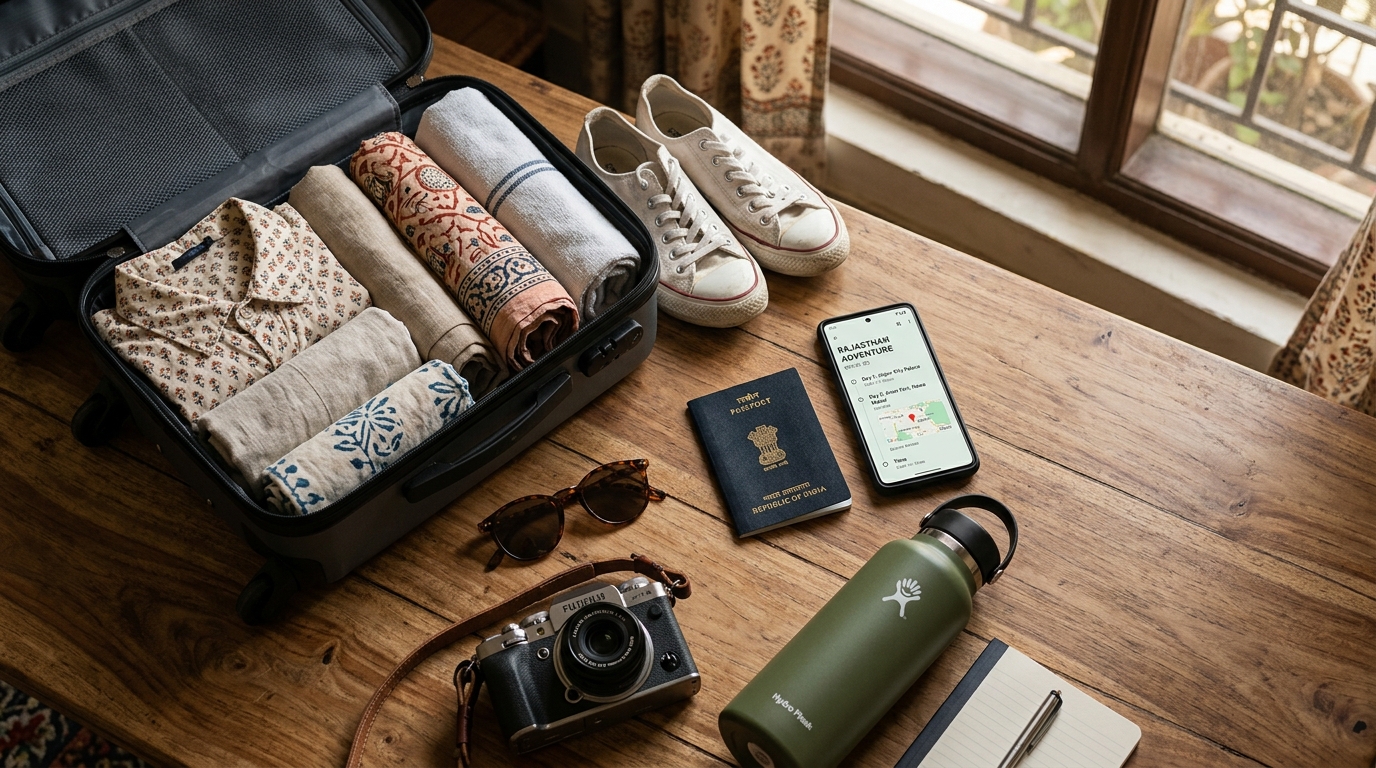
Europe Summer Packing: Sweat-Proof Fabric Guide
Most packing guides tell Indians to pack cotton for European summers. But cotton absorbs sweat, weighs 30% more when damp, and dries slowly—turning your luggage into a water-logged mess by day three. Merino wool and high-performance synthetics don't just breathe better; they cut your total bag weight by 40% and let you rotate fewer clothes across a three-week trip. That's the difference between checking a bag (₹3,000–5,000 extra) and staying under 7 kg carry-on.
1. Why Merino Wool Beats Cotton for European Heat
Merino wool is not itchy—the fiber diameter is 15–20 microns, half that of regular wool. Your skin won't feel it. What it will do is wick moisture away from your body while keeping you cool, thanks to its natural crimp that traps air pockets without trapping heat.
Cotton does the opposite. It soaks up 27% of its weight in water before you even feel damp. Once wet, it stays wet for hours, clings to your body, and takes 8–10 hours to air-dry in a European hotel room. Merino dries in 4–5 hours and stops smelling even after five days of wear.
Here's the hardnumber breakdown of what each fabric holds in moisture:
| Fabric | Moisture absorption (% of weight) | Dry time (hours) | Odor after 5 days | Weight per t-shirt (grams) |
|---|---|---|---|---|
| Cotton | 27% | 8–10 | Strong | 180–200 |
| Merino wool | 35% (but wicks away) | 4–5 | Minimal | 140–160 |
| Synthetic polyester | 0.4% | 2–3 | Moderate | 120–140 |
| Merino-synthetic blend | 18% (wicks fast) | 3–4 | Very minimal | 150–170 |
You'll notice merino absorbs more moisture than cotton, but it wicks it away—it doesn't hold it against your skin. The difference matters when you're walking 15,000 steps through Barcelona in 28°C heat.
Real cost: A Merino t-shirt (₹2,500–3,500 from Decathlon India, Wildcraft, or international brands at Mumbai/Delhi duty-free) vs. regular cotton (₹400–800). Over a month-long trip where you wear 8–10 shirts, buying 3–4 Merino pieces and rotating them beats packing 8 cotton ones.
2. Synthetic Quick-Dry Fabrics That Pack Flat
Not everyone needs or wants Merino. Synthetic blends—nylon, polyester, elastane mixes—are cheaper, pack 60% smaller when compressed, and dry in under three hours. They're your backup.
The best performers for Indian travelers are:
- Polyester-elastane blends (88/12 or 85/15 ratio): Used by brands like Decathlon, Nike, Adidas. Stretch, form-fitting, and nearly odor-proof. ₹600–1,200 per piece.
- Nylon micro-weave: Ultra-light and compressible. Popular in travel wear from brands like Peak Design's collaborators. Feels slightly plasticky but dries in 90 minutes. ₹1,500–2,500.
- Recycled polyester: Emerging option from brands sold on Amazon India and Flipkart. Eco-conscious, same performance as virgin polyester. ₹800–1,800.
Where synthetics fail: they hold odor faster than Merino (after 3–4 days) and feel less breathable in extreme heat. But for a two-week trip with laundry access, they're 50% cheaper and pack into a ball the size of an apple.
Packing math: 3 Merino shirts + 2 synthetic quick-dry shirts + 1 linen shirt (for evening) = 6 tops for 21 days. That's 180g of Merino + 260g of synthetics + 150g linen = 590g total vs. 1,400g if you packed cotton.
3. Bottoms, Layering, and the 40% Weight Reduction
Where the real luggage savings happen is below the waist. Cotton jeans weigh 600–800g each. Travel pants in nylon-spandex blends weigh 280–380g and pack to 1/5 the volume.
For a European summer (May–September), your bottom layer should be:
- One pair of travel trousers (nylon-elastane, flat-front, convertible): Decathlon Quechua or Wildcraft brands run ₹1,200–2,000. Weight: 320g. Packs to the size of a water bottle.
- One pair of shorts (synthetic, 5-inch inseam, with deep pockets): ₹800–1,500. Weight: 180g.
- One linen skirt or linen shorts (if you prefer): Cotton-linen blends breathe but are heavier. Pure linen is 30% lighter. ₹1,500–2,500. Weight: 200g.
Avoid: Denim. Cotton cargos. Anything with a button fly—they weigh more and take space.
Layering for cool mornings (yes, Paris is 18°C at 8 AM):
- Merino 200-weight hoodie or half-zip: Compact, warmth-to-weight ratio of 4:1. ₹2,500–4,000. Weight: 350g.
- Synthetic packable rain jacket: Nylon shell, folds into its own pocket. ₹1,500–3,000. Weight: 200g.
- Skip the cardigan. Merino or synthetic layers do the job.
A full summer wardrobe—tops, bottoms, layers—in high-performance fabrics weighs 2.5–2.8 kg. Cotton packs to 4.2–4.8 kg. That's your 40% saving right there—and you've eliminated the need for checked luggage, cutting your flight cost by ₹3,000–5,000 from Indian hubs.
Use the Trip budget calculator to factor in the upfront fabric investment against luggage fees over multiple trips.
4. Underwear, Socks, and Accessories (Don't Overlook These)
Underwear is where travelers lose 500g unnecessarily. Regular cotton briefs or boxers weigh 25–30g each; you'd pack 10–12 pairs for 21 days. Merino or synthetic moisture-wicking underwear weighs 12–15g, and you only need 4–5 pairs.
- Merino underwear (unisex, mid-weight): ₹600–1,200 per pair. Lasts 3–4 wears. Buy 4 pairs = 60–75g total for 21 days.
- Synthetic blends: ₹300–600 per pair. Buy 6–7 pairs = 85–105g total.
- Avoid: Regular cotton briefs. They're 30g, need daily washing, and dry slowly.
Socks: This matters. European summers aren't sock season, but you need 2–3 pairs for museums (strict shoe-free policies), layering on trains, and unexpected rain.
- Merino lightweight crew socks: ₹400–800 per pair. Breathable, odor-proof. Buy 3 pairs = 60–75g.
- Synthetic hiking socks: ₹200–400 per pair. Heavier cushioning but unnecessary for summer walking. Skip these.
Accessories that weigh almost nothing but matter:
- Lightweight scarf (linen or silk-blend, not cotton voile): Doubles as beach cover, mosque entry, and evening layer. ₹500–1,200. Weight: 50g.
- Lightweight compression bag for clean clothes: Reduces volume by 50%. ₹300–600. Weight: 30g.
Use the Free AI itinerary generator to map your daily activities—that tells you if you need formal shoes (add weight) or can stick to one pair of travel sandals + one pair of sneakers.
5. The Laundry Strategy That Halves What You Pack
Here's what travel guides never say: you don't pack 21 days of clothes. You pack 7–10 days, then do laundry. European laundromats charge ₹400–800 per load. Hotel laundry runs ₹1,200–2,000 per load. Airbnb apartments with washing machines save you both.
Merino and synthetic clothes cut laundry frequency in half. A Merino shirt can be worn 3–4 times before washing. A synthetic shirt, 2–3 times. Cotton needs washing after one day in heat.
Realistic packing for 21 days with one laundry session (day 10–11):
- 4 tops (3 Merino, 1 synthetic) → rotated twice = 8 wear-days covered
- 2 bottoms (travel trousers, shorts) → worn 5 times each before washing
- 1 hoodie → worn 3–4 times before washing
- 5 underwear sets → one wash mid-trip
- 3 socks pairs → worn 2–3 times each
Total bag weight: 2.2 kg for clothing. Add shoes (sneakers 350g, sandals 200g), toiletries (400g), electronics (800g), miscellaneous (300g) = 4.25 kg total. You're under carry-on limits on every Indian carrier (Air India, IndiGo, SpiceJet allow 7 kg).
Compare this to a cotton packing list: same 21-day trip requires 14 tops, 4 bottoms, 10 underwear sets, 8 socks pairs = 7.8 kg clothing alone. Add the rest, and you're at 10+ kg. Checked bag. Extra fees.
Visit the Trip reality check tool to input your destination and see what laundry access looks like in your chosen cities—that informs your packing volume.
6. Regional Fabric Swaps for Specific Routes
Not every European summer is the same heat profile. Barcelona (28–30°C, humid) needs different fabrics than Edinburgh (16–18°C, dry).
| Route | Temperature (°C) | Humidity | Best primary fabric | Secondary fabric | Skip entirely |
|---|---|---|---|---|---|
| Spain (Madrid, Barcelona) | 28–32 | High | Merino 150-weight | Linen | Heavy synthetics |
| Italy (Rome, Venice) | 26–30 | High | Merino 150-weight + nylon shorts | Cotton-linen blend | Denim |
| France (Paris, Provence) | 22–28 | Medium | Merino 200-weight | Synthetic polyester | Cotton |
| Greece (Athens, islands) | 28–32 | Medium–high | Merino 150-weight + linen | Nylon quick-dry | Anything long-sleeved |
| Portugal (Lisbon, Porto) | 24–28 | High | Synthetic polyester blend | Linen | Thick cotton |
| UK/Ireland (London, Dublin) | 18–22 | Low–medium | Merino 200-weight hoodie | Packable nylon jacket | T-shirts alone |
| Switzerland/Austria (Alps) | 16–24 (altitude-dependent) | Low | Merino 200-weight + nylon layer | Fleece | Cotton long-sleeves |
Real-trip example: A two-week Spain + Italy route (hot, humid) needs 60% of your packing volume if you use Merino and synthetics vs. cotton. Budget the savings into experiences: ₹5,000 fewer baggage fees = 2–3 extra meals at Michelin-listed restaurants or a wine-tasting tour.
Check the Forex & bargain check tool to see current price conversion for European retail—sometimes buying a Merino shirt in Barcelona (€18–25) is cheaper than pre-buying in India.
Frequently Asked Questions
Is Merino wool too warm for a European summer?
No. Merino has a low thermal index—it regulates temperature rather than trapping heat. A 150-weight Merino shirt (the weight standard is in grams per square meter) is cooler than a cotton shirt in hot climates because it wicks moisture and allows air circulation. Thinner Merino (100–130 weight) is available in India through Decathlon and international e-commerce platforms; these feel identical to a cotton t-shirt but breathe better.
How often do I really need to wash Merino clothes?
Merino can be worn 4–5 times before washing, thanks to its antimicrobial properties (a natural lanolin-based property of the fiber). Synthetics need washing after 2–3 wears in summer heat. Cotton needs daily washing. For a 21-day trip with one mid-point laundry session, 3–4 Merino shirts is genuinely enough if you rotate them daily.
What's the price difference between Merino and cotton in India?
A basic cotton t-shirt costs ₹400–800 locally. Merino t-shirts from Decathlon (India), Wildcraft, or international duty-free shops run ₹2,500–3,500. Synthetics are ₹600–1,200. Upfront, Merino is 3–4× more expensive, but over three trips, the cost-per-wear flattens out, and you eliminate checked baggage fees (₹3,000–5,000 per flight).
Can I buy these fabrics in Europe if I travel light initially?
Yes, but it's expensive. A Merino shirt in a European outdoor retailer (Decathlon stores exist across EU, but markup is 20–30% vs. India) costs €18–28. Buying in India before departure is cheaper. However, if you're over baggage limits, buying one Merino piece in Barcelona on day 3 (after laundry) is often worth it—you save 500g by ditching a cotton shirt and upgrade your comfort.
Do synthetic quick-dry clothes ever smell bad, even after one wash?
Yes, synthetic fabrics trap odor-causing bacteria in their weave—it's a known downside. Merino naturally resists odor (the lanolin again), which is why it stays fresher longer. If you're packing synthetics, treat them with a fabric freshener (₹300–500 from Amazon India) or use a vinegar soak (1:4 ratio in cold water) during laundry to reset the smell. Merino rarely needs this.
Pack Smarter, Travel Lighter
European summers demand fabrics that work as hard as you do. Merino wool and high-performance synthetics aren't luxury items—they're logistics. You'll rotate fewer clothes, save ₹3,000–5,000 on baggage fees, and have room in your carry-on for souvenirs instead of forced laundry days.
Start with one Merino shirt and one pair of synthetic travel trousers on your next trip. Track the difference in bag weight, laundry frequency, and overall comfort. Then rebuild your travel wardrobe around what actually works for Indian summer-to-European summer transitions.
Don't guess your packing list. Generate your free AI itinerary → and get a fabric-optimized packing guide tailored to your specific route, dates, and planned activities.