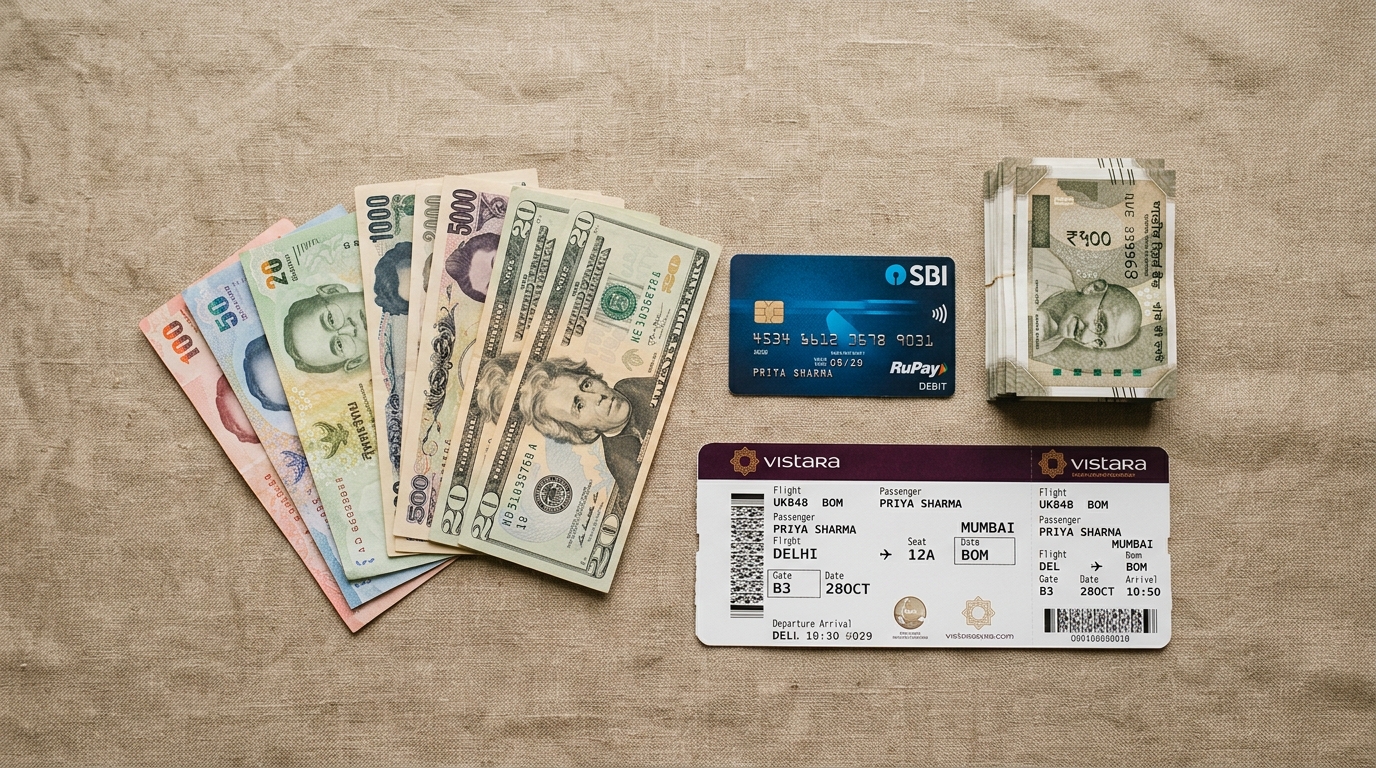
Forex Hacks for Asia: Card vs. App vs. Cash Compared
Most Indian travelers assume credit cards and ATMs are interchangeable—both pull from the same rupee pool. In reality, a single transaction method can cost you 8–12% more than another, and Asia's competitive forex ecosystem has made intentional choice a superpower. This breakdown compares real fees, real rates, and real margins so you stop bleeding money between Mumbai and Maldives.
1. The Forex Spread Trap: What Actually Costs You
Credit cards, apps, and ATMs don't exchange money at the Reserve Bank's true rate—they all mark it up. Your bank adds a percentage. The forex dealer adds a percentage. The ATM operator adds a percentage. That stacking is where most travelers leak 5–8% of their budget without realizing it.
When you see an exchange rate, it's not one number. It's a two-way market: the interbank rate (what banks pay each other), then the retail markup. On ₹1,00,000 (roughly USD 1,200), a 2% difference is ₹2,000. A 5% difference is ₹5,000. Over a month-long Asia trip, that's your hotel upgrade or it's gone.
The calculation is simple but most guides skip it:
- Interbank rate (true market price): USD 1 = ₹83.50 (example)
- Your card rate (after bank markup + Visa/Mastercard fee): USD 1 = ₹85.00
- Your loss per USD: ₹1.50 per dollar
- Your loss on USD 2,000 spend: ₹3,000 (~INR 3,600 at market rates)
To beat this, you need to know your specific card's forex margin and choose the payment method that minimizes it. Use our Trip budget calculator to reverse-engineer how much of your spend will actually leave your account in foreign currency vs. how much the system eats.
2. Credit & Debit Cards: Fee vs. Rate Trade-Off
Indian credit cards charge a foreign transaction fee (usually 1.5–2%) on top of the markup. Debit cards often charge the same or more. Visa and Mastercard then add their own assessment fee (roughly 0.8–1.2% on top of the interbank rate). The result: your card might offer an effective rate that's 3–4.5% worse than true market.
Best cards for Asia travel (as of 2024):
| Card | Forex Fee | Additional Perks | Best For |
|---|---|---|---|
| HDFC Bank Regalia Gold | 0% on spends >₹1L/month | Lounge access, insurance | High-spend travelers |
| ICICI Bank Sapphiro | 0% after spends >₹15L/year | Priority banking | Corporate frequent fliers |
| Amex Platinum Travel | 0% markup | Concierge, hotel credits | Luxury travelers (higher fees offset) |
| Standard debit card | 1.75–2% | None | Last resort only |
Cards shine when you're building spend toward a waiver or earning points. But on a two-week Asia trip, you might not hit thresholds. Even a "0% markup" card still loses to apps when the app locks a live rate and your card company processes it 24 hours later (forex moves fast in Asia).
One real example: ₹1,00,000 spent via HDFC Regalia at 1% Visa fee + 2% bank markup = effective rate of ₹85.80 per USD. Same ₹1,00,000 via Wise app = ₹83.60 per USD (0.6% markup only). Difference: ₹2,200 in favor of Wise. Over a month, that's significant.
3. Wise (TransferWise): The Rate Killer
Wise is not a bank—it's a peer-to-peer forex market. You don't buy USD from Wise; you swap your INR with someone else's USD at true interbank rates. Wise's fee is upfront: 0.6–1.2% depending on amount and destination. No hidden markups. No forex spreads. That transparency is why it dominates for Asia travel.
Here's the math:
- Interbank rate: USD 1 = ₹83.50
- Wise markup: 0.6–1.2% (let's say 0.8%)
- Your effective rate: USD 1 = ₹83.82
Compare that to a credit card (3–4.5% markup) or local ATM (typically 2–2.5% markup + local bank fee). Wise wins almost every time for Asia.
Where Wise is not the best choice:
- Small transactions (under ₹5,000): Fixed fees eat the saving.
- Urgent transfers (same-hour): Banks are faster; Wise takes 1–2 hours.
- Offline/cash-only areas: Wise is digital only—you need an app and internet.
- Countries with forex restrictions (rare in Asia): Some nations limit app-based transfers.
For most Indian travelers, Wise card (which comes with your account) is the best foreign-spend tool. Load INR, hold it in your chosen currency, spend at true interbank rates. No markup. No guessing.
4. ATM Withdrawals: Hidden Fees + Rate Lag
ATMs feel "safe" because you're just withdrawing local cash. But you're paying two sets of fees: your Indian bank's international withdrawal fee (usually 1–2% per ₹1,000 withdrawn) plus the local ATM operator's fee (which varies wildly in Asia—sometimes ₹300–₹500 per withdrawal).
On ₹10,000 withdrawal:
- Your bank: ₹100–₹200 (1–2%)
- Local ATM fee: ₹300–₹500
- Total: ₹400–₹700 (4–7%)
- Plus the forex rate is whatever your bank's correspondent bank agreed to (often 1–2% worse than interbank)
Real example from Southeast Asia:
| Destination | ATM Fee (Local) | Bank Fee (₹) | Total Cost per ₹10K | Time to Process |
|---|---|---|---|---|
| Bangkok | 150–200 THB | ₹150 | ~₹550 (5.5%) | 1 hour |
| Singapore | SGD 1.50–2 | ₹100 | ~₹300 (3%) | 1 hour |
| Kuala Lumpur | RM 5–6 | ₹100 | ~₹400 (4%) | 1 hour |
| Ho Chi Minh City | VND 20K–30K | ₹150 | ~₹600 (6%) | 1 hour |
ATMs make sense when:
- You need cash urgently and card machines are down.
- You're in a destination where small cards aren't trusted (rural areas, street markets).
- You have a premium debit card with waived ATM fees (rare; check your bank).
For planned spending, Wise + card spend beats ATM every time.
5. Hybrid Strategy: Card, App, and Cash Combined
The smartest travelers don't choose one method—they layer them.
Your optimal Asia trip setup:
-
Load Wise card with ₹1,50,000–₹2,00,000 before departure. Lock the rate. Spend it for everyday stuff (hotels, restaurants, tours). Cost: 0.8% spread = ₹1,200–₹1,600 total on the trip.
-
Carry a credit card (HDFC Regalia or Amex) as backup. Only use it if Wise card fails or for emergency large purchases. Cost: 2–3% if used. But you don't use it most days.
-
Withdraw cash once per city at the best-rate ATM (not all ATMs are equal—ask your hotel). Withdraw medium amounts (₹20,000–₹30,000) to minimize per-withdrawal fees. Use cash in markets, tips, taxis where cards aren't accepted. Cost: 4–5% but unavoidable for physical transactions.
-
Use local e-wallets (GrabPay in Southeast Asia, Alipay/WeChat in East Asia) where available. These are often free if you load them via Wise or card. Cost: 0%.
Real monthly budget breakdown for ₹3,00,000 Asia trip:
| Method | Amount (₹) | Effective Fee | Actual Cost |
|---|---|---|---|
| Wise card (hotels, restaurants) | ₹1,80,000 | 0.8% | ₹1,440 |
| Credit card backup (emergency) | ₹40,000 | 3% | ₹1,200 |
| ATM cash (markets, taxis) | ₹60,000 | 5% | ₹3,000 |
| Local e-wallet | ₹20,000 | 0% | ₹0 |
| TOTAL | ₹3,00,000 | ~2.2% | ₹5,640 |
Compare that to using only your credit card for everything (3.5% average cost): ₹10,500. You save ₹4,860 just by splitting methods.
6. Asia-Specific Considerations: Currency, Speed, Trust
Not all Asian countries treat forex apps and cards the same way. Visa and Mastercard are nearly universal, but some nations prefer local payment methods or have limits on app-based transfers.
Quick guide by destination:
| Country | Best Card Method | Best App | Cash Still Needed? | Notes |
|---|---|---|---|---|
| Thailand | Mastercard (Bangkok Bank ATMs good rates) | Wise | 40% | Markets, temples, taxis. GrabPay also works. |
| Vietnam | Visa preferred | Wise | 50% | Many hawkers cash-only. Rates poor. Avoid ATMs. |
| Indonesia | Both | Wise | 35% | GrabPay, OVO, Dana integrated. Card acceptance growing. |
| Philippines | Mastercard preferred | Wise | 30% | Manila modern; provinces need cash. |
| Malaysia | Both | Wise | 25% | Most places card-ready. Cash for tipping only. |
| Singapore | Both | Wise | 10% | Nearly 100% card acceptance. Cash unnecessary. |
Why card speed matters: When you pay with a card, the merchant's bank and your bank may process it over 24–48 hours. Your forex rate is locked when the payment clears, not when you swipe. If the rupee weakens during that window, you lose. Wise locks the rate instantly. Apps like Google Pay (if your bank supports) do the same.
Frequently Asked Questions
Is Wise really safe for travel to Asia?
Yes. Wise is licensed in the UK and operates under FCA regulation. You hold funds in a Wise account, and the card is a Mastercard (the network, not Wise itself, processes payments). Your money is insured up to £85,000 in the UK and equivalent sums in other jurisdictions. In Asia, Wise Mastercard works wherever Mastercard is accepted—which is nearly everywhere except some remote villages. Billions of rupees move through Wise daily without fraud or loss. The main risk is personal (theft of the card itself), not institutional.
How far in advance should I load my Wise card before an Asia trip?
Load it 3–5 days before departure. This gives the transfer time to settle (typically 1–2 business days from Indian banks) and lets you verify the card is active. Don't load on the day of travel; if there's a glitch, you'll have no backup. If you're traveling mid-week, load on the preceding Monday. Check Wise's rate daily for the 3 days before your trip—if the rupee weakens (bad for you), load earlier; if it strengthens (good for you), wait. But don't optimize too much; the difference between "today's rate" and "three days ago's rate" is usually <1%, which is less than ATM fees anyway.
What's the difference between a Wise card and a Wise transfer?
A Wise transfer is one-time money movement: you send ₹50,000 from your Indian account to a Wise account in USD or another currency. Takes 1–2 hours. Good for paying a hotel in advance. A Wise card is a reusable Mastercard linked to your Wise account. You load it once (or repeatedly) and spend anywhere. Transfers are for bills; cards are for travel. Most travelers just need the card.
Can I use multiple cards to avoid daily limits on card spends?
Yes, but impractically. Each card has its own issuing bank and daily/monthly limits. If you carry an HDFC card and an ICICI card, you can hit both their limits separately. But in Asia, most hotels and restaurants won't run two cards for the same bill (it's a security red flag). Use multiple cards as backups, not to circumvent limits. Also check your card's overseas daily limit before travel—some banks cap international spends at ₹1,00,000 or ₹2,00,000 per day. Call your bank 48 hours before travel to raise limits if needed.
Should I get travel insurance that covers forex loss or rate fluctuation?
No. Travel insurance covers trip cancellation, luggage loss, and medical emergencies—not exchange rate risk. Even specialized "forex insurance" products are rare and costly. Instead, mitigate forex risk by locking rates early (load Wise 3–5 days before, not the night before) and using cards instead of ATMs when possible. If you're paranoid about a major rupee devaluation, buy your foreign currency a week in advance. But for a 2-week trip, rate movements rarely exceed 1–2%, which is small compared to method choice (5–6% difference).
Your forex choices are not small. A 3% mistake compounds to ₹9,000 on a ₹3,00,000 trip—a night in a great hotel, or three dinners you won't have. Use Wise for daily spends, credit card as backup, and cash only where card readers are absent. Check our Forex & bargain check tool before each trip to lock the best available rate. Generate your free AI itinerary → and we'll break down your trip's expected spend by category, so you know exactly how much forex you need.