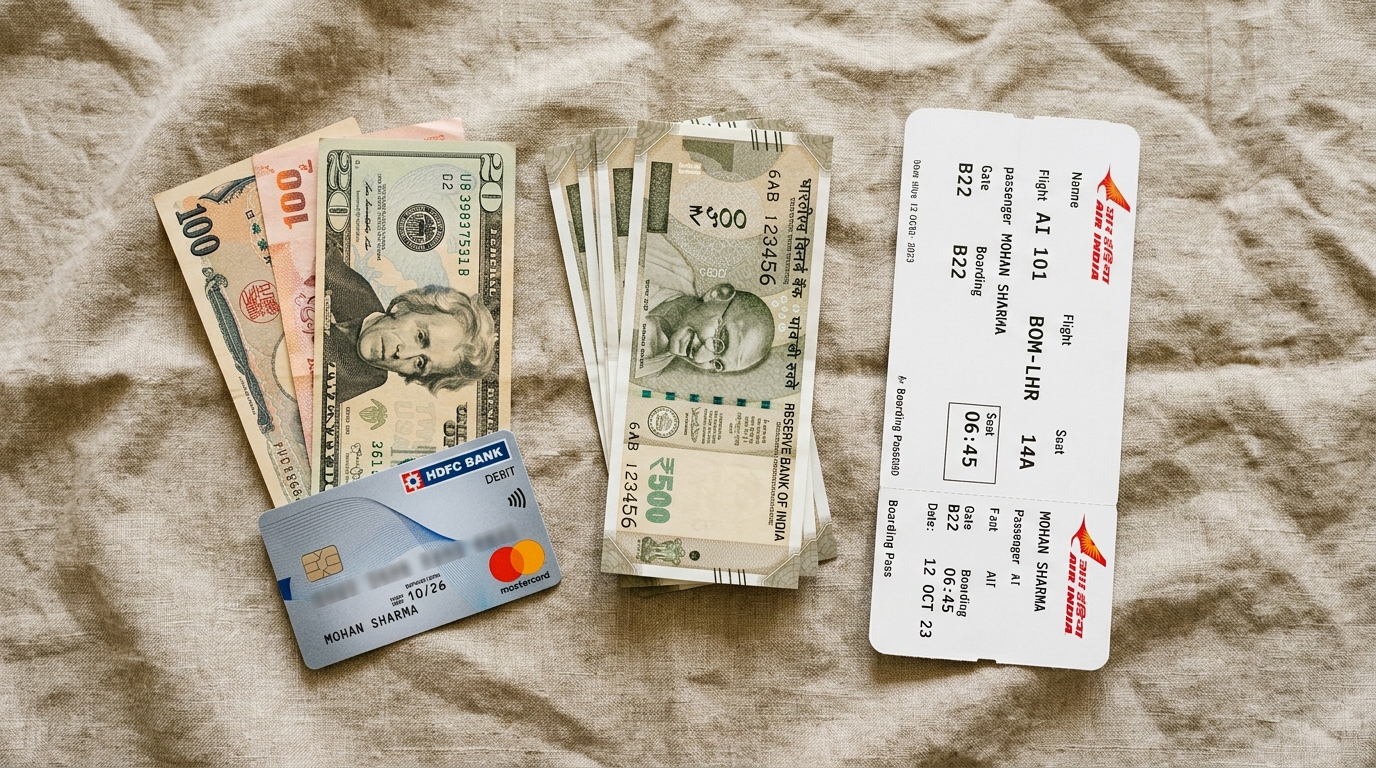
Forex Strategy for Asia: Card vs. App vs. Cash Compared
Most travel guides tell Indians to "just use your bank card and withdraw at ATMs." Generic AI planners never break down the hidden fees that drain ₹500–2,000 per trip. The truth is that forex cost is a three-way fight between old-school bank cards, new apps like Wise, and cold hard cash—and which one wins depends entirely on your destination, withdrawal size, and length of stay.
1. The Real Cost: Hidden Fees Decoded
Your bank card's advertised 3–4% forex markup is a lie. The true cost includes the markup, ATM fees, convenience charges, and currency conversion timing spreads. A single ₹10,000 withdrawal in Bangkok using an HDFC debit card can cost you ₹1,200–1,500 in total friction. But if you use Wise, the same ₹10,000 costs ₹150–200.
The breakdown matters because small decisions compound. A two-week Asia trip with 5–6 cash withdrawals can mean the difference between ₹4,000 and ₹8,000 in forex costs—enough to cover 2–3 extra meals or a domestic flight upgrade.
Here's what each method actually costs you:
| Method | Markup % | ATM Fee (local) | Convenience Fee | True Cost per ₹10K | Notes |
|---|---|---|---|---|---|
| HDFC Bank Card | 3.5% | ₹150–250 | ₹100 | ₹600–700 | Most Indian banks similar |
| ICICI Bank Card | 3.75% | ₹180–250 | ₹100 | ₹700–750 | Slightly worse than HDFC |
| Wise App | 0.6% | None | None | ₹60–100 | Mid-market rate; transfer then card |
| Local ATM (direct) | Variable | ₹200–300 | None | ₹350–500 | Depends on country; often hidden markup |
| Cash (USD/SGD) | 2.5–3% | — | — | ₹300–400 | If exchanged at airport; poor timing risk |
The pattern is clear: Wise wins on pure fees, but only if you plan ahead. Bank cards are convenient but bleeding expensive. Cash beats both if you exchange it intelligently, but timing risk is real.
2. When to Use Your Bank Debit Card (And When Not To)
Your bank card is the safety net, not the primary weapon. Use it in exactly three scenarios: (1) emergency withdrawals in countries where Wise accounts are blocked, (2) small top-ups when you've miscalculated, and (3) card payments at chain hotels or restaurants that don't take cash.
Never—repeat, never—use your bank card for street-level ATM withdrawals in Southeast Asia. A ₹5,000 withdrawal in Phuket via HDFC charges you ₹350–400 in hidden costs. Do it six times over two weeks and you've paid ₹2,100–2,400 for the privilege of carrying plastic.
The bank card makes sense in these specific cases:
- Singapore and Hong Kong, where ATM fees are low (₹80–120) and forex markups are competitive. A ₹10,000 withdrawal costs you only ₹550–650.
- Payment-only mode in malls and restaurants. Your HDFC card in Bangkok's Emporium mall carries a 3.5% markup but zero ATM fees—acceptable for a ₹2,000 purchase.
- Emergencies after hours when every other option is closed.
For weekend trips to Bangkok or Phuket, stick with your debit card if you're only withdrawing once. The ₹600–700 cost on a ₹10,000 withdrawal is worth the simplicity. But for longer stays or repeat withdrawals, you're leaving money on the table.
Use your trip budget calculator to estimate how many withdrawals you'll actually need. If it's more than 3–4, switch strategies immediately.
3. Wise: The Game-Changer (If You Plan 2–3 Days Ahead)
Wise (formerly TransferWise) has killed the forex arbitrage in Asia for Indians who prepare. You create a Wise account from India, link your HDFC or ICICI account, and transfer ₹10,000–₱500,000 at a time to a Wise multi-currency balance. Then you use the Wise debit card to withdraw local currency at ATMs or pay directly at merchants.
The real advantage is the mid-market rate. When the INR-to-THB rate is 1.32, Wise gives you exactly 1.32 (or 1.318 with their 0.6% internal markup). Your bank gives you 1.28 or worse. On ₹10,000, that's ₹300–400 saved immediately, before ATM fees even enter the picture.
Here's the math for a 14-day Thailand trip:
- Method 1 (HDFC card, 6 withdrawals): 6 × ₹700 = ₹4,200 total forex bleed.
- Method 2 (Wise, 3 top-ups of ₹15,000 each): 3 × ₹90 = ₹270 total forex bleed.
- Savings: ₹3,930 on the same trip.
The catch: Wise has a transfer delay (1–2 days in India to Wise account). You must plan your trip 3–4 days in advance. For last-minute trips, Wise is useless.
Key Wise rules for Asian travel:
- Open your Wise account NOW (takes 10 minutes from India).
- Transfer your first batch of INR 2–3 days before departure. This lands in your Wise balance in 24–48 hours.
- Convert INR to Thai Baht (or SGD, MYR, PHP) directly in the Wise app at mid-market rates.
- Use the Wise card to withdraw at any ATM. Wise refunds ATM fees worldwide.
- For longer trips (3+ weeks), top up your balance mid-trip via a second transfer.
Wise is not free. They charge a 0.6% markup on the mid-market rate, plus you pay INR-to-local currency conversion fees (usually ₹100–150 per conversion). But even with these fees, you're 60–70% cheaper than your bank.
Don't use Wise for card payments. Wise's card payment markup is 1.5–2%, higher than your bank. Only use Wise for ATM withdrawals and direct local payments.
Check our forex & bargain check tool to compare real-time rates for your destination.
4. Cash: The Underrated Backup (With Right Timing)
Carrying cash is not retro—it's a calculated risk hedge. India's forex market at home (pre-departure exchange) is often 0.5–1.5% better than on-ground ATM rates in Southeast Asia. If you exchange ₹50,000 before leaving India, you lose ₹750–1,500 to markup. If you withdraw the same amount from ATMs abroad, you lose ₹2,500–3,500.
The maths flips in your favor if you exchange smartly.
Cash strategy for Asian trips:
- Exchange ₹30,000–50,000 (depending on trip length) at your home city's forex dealer (not the airport). Dealers in Bangalore, Mumbai, and Delhi offer rates 0.3–0.8% better than airport counters.
- Convert to USD at your home-city rate, then to local currency (THB, SGD, MYR) once you land. This two-step avoids airport markup.
- Carry the cash in a money belt, not your wallet. Petty theft happens; catastrophic loss is rare if you split it.
- Keep ₹5,000–10,000 INR in your wallet as an emergency re-exchange buffer.
- Use the cash for street food, taxis, night markets, and temples—places where Wise or cards don't work.
Real-world example for a 10-day Chiang Mai trip:
| Forex Method | INR Spent | Local Currency Received | Effective Cost per ₹1 |
|---|---|---|---|
| Home city dealer (USD → THB) | ₹50,000 | ฿1,695 | ฿0.0339 |
| Airport exchange (INR → THB) | ₹50,000 | ฿1,620 | ฿0.0324 |
| HDFC ATM withdrawal | ₹50,000 | ฿1,565 | ฿0.0313 |
| Wise withdrawal (ATM refunded) | ₹50,000 | ฿1,705 | ฿0.0341 |
The winner depends on timing. If USD is weak against INR on your departure day, home exchange wins. If Wise mid-market is strong, Wise wins. Cash is middle ground—not the cheapest, but consistent and zero-stress.
Never exchange cash at the airport. Ever. The markup is 4–6%. You're paying ₹2,000–3,000 tax for the convenience of arriving with zero planning.
5. The Hybrid Strategy: Where You Actually Save Money
The pros don't choose one method. They stack them.
The Flycher Asia Forex Plan:
For a 10–14 day trip across 2–3 countries, here's what the math says:
- Pre-departure (3 days before): Transfer ₹80,000 to Wise. Convert ₹50,000 to primary currency (THB if Thailand-heavy). Keep ₹30,000 as INR buffer in Wise (to convert later at better rates or emergency).
- Day of arrival: Withdraw ฿1,200–1,500 from a local ATM using the Wise card. Wise refunds the ATM fee. Cost: ₹90–120 (Wise's 0.6% markup only).
- Week 1: Use cash for 80% of spending (markets, food, taxis). Use Wise card for hotel pre-payments and big purchases. Zero ATM withdrawals.
- Week 2: When cash runs low, convert ₹20,000 more from Wise (now you're timing the FX better, mid-trip). Withdraw locally once more.
- Backup: Carry your HDFC card for absolute emergencies only.
Total forex cost for ₹80,000 trip budget:
- Wise transfers + conversions: ₹200–250
- ATM withdrawals (2 × Wise): ₹0 (refunded)
- Home-exchanged cash (₹30,000): ₹750
- Total: ₹950–1,000 (1.2% of trip spend)
Compare this to the bank-card-only traveler:
- 6 ATM withdrawals × ₹700 = ₹4,200
- Total: ₹4,200 (5.2% of trip spend)
Savings: ₹3,200 on an ₹80,000 trip. That's 4% pure arbitrage.
The hybrid approach works because:
- Wise handles the bulk (60–70% of spending) at true mid-market rates.
- Cash covers daily spend where digital doesn't work (temples, street carts, rickshaws).
- Bank card sits idle as insurance, not primary tool.
- You avoid multiple ATM fees by planning withdrawals.
Before you finalize your forex plan, run your specific destinations through our trip reality check. The cash/card split changes for places like Vietnam (cash-heavy), Singapore (card-heavy), and Myanmar (cash-only, but restricted).
6. Country-by-Country: Which Method Wins in Asia
Forex costs vary wildly across Asia. Thailand rewards cash + Wise. Singapore rewards cards only. Vietnam demands cash. Here's the practical guide:
| Country | Best Method | Why | Cost per ₹10K |
|---|---|---|---|
| Thailand | Wise + cash | ATM fees low, mid-market rate strong | ₹150–200 |
| Vietnam | Cash only | Most vendors reject cards; ATMs charge ₹300+ | ₹400–500 |
| Singapore | Wise card | Low ATM fees, excellent FX rates | ₹80–120 |
| Philippines | Wise + cash (50/50) | Card + cash equally accepted | ₹200–250 |
| Malaysia | Wise card | Liberal ATM network, good FX | ₹100–150 |
| Indonesia | Cash + Wise | Bali touristy (Wise good); rural areas need cash | ₹250–300 |
| Cambodia | Cash + USD | USD accepted everywhere; local ATMs unreliable | ₹400–450 |
Thailand dominance: For ₹10,000, Wise costs ₹60, ATM fee is refunded, forex markup is minimal. If you need cash (temples, markets), exchange ₹3,000 at home before departure.
Vietnam anomaly: Most local retailers, even mid-range hotels, don't accept cards. You must carry cash. Withdraw from ATMs at major cities (Hanoi, Ho Chi Minh City) where fees are lower. Wise card works but use it only for hotel/airline bookings. Street level is 95% cash.
Singapore exception: Your bank debit card works perfectly here. Forex spread is 2.5–3%, ATM fees are ₹80–120, and card payments are ubiquitous. Wise doesn't add value unless you're there for 3+ weeks.
Philippines wildcard: 50/50 split. Manila is card-heavy; provincial towns need cash. Wise + one ATM withdrawal = optimal.
Use the visa wizard for Indians to check entry requirements by country. Some countries (Myanmar, Laos) have cash-only visa-on-arrival fees; factor that into your forex plan.
Frequently Asked Questions
How much should I carry as cash vs. use Wise on a 10-day Thailand trip?
For Thailand, carry ฿3,000–5,000 (₹7,000–12,000) as cash for temples, markets, and street food. Load the remaining budget (₹45,000–60,000) onto Wise. Thailand's ATM fees are low and merchants accept cards widely, so Wise withdrawals are efficient. This split saves you ₹2,500–3,000 compared to relying on bank cards.
Why does Wise require 2–3 days for transfer if I'm leaving in 4 days?
Wise transfers from India take 1–2 business days due to NEFT clearing and their back-office processing. If you initiate a transfer on a Wednesday evening, it lands Friday morning. This is why you must transfer at least 3 days before departure. For last-minute trips (48 hours or less), Wise is unreliable—stick with your bank card or pre-exchange cash at home.
Is it safer to carry ₹50,000 as USD cash or exchange it on arrival in Thailand?
Carrying USD cash is safer than carrying INR, because USD is globally recognized and has tighter spreads. Exchange USD to Thai Baht on arrival, not INR. The two-step (INR → USD at home, USD → THB locally) costs you 0.5–1% but is more secure than carrying INR cash abroad. Never exchange INR at Bangkok airport; the spread is 4–6%.
What's the real difference between Wise's 0.6% markup and my bank's 3.5% markup?
On ₹10,000, Wise costs ₹60 (0.6% markup) + ₹0 (ATM fee refunded) = ₹60 true cost. Your bank costs ₹350 (3.5% markup) + ₹150 (ATM fee) = ₹500 true cost. That's 8x the expense. Over 5–6 withdrawals on a longer trip, Wise saves ₹2,500–3,000. Wise's 0.6% includes their operational costs; your bank's 3.5% is pure profit on forex arbitrage.
Can I use my Indian bank's international digital wallet (Google Pay, Apple Pay) abroad instead of a physical card?
Google Pay and Apple Pay transmit your bank's card details, so you incur the same 3.5–4% forex markup. They're as expensive as swiping your physical card. Digital wallets don't bypass forex fees—they only avoid the friction of finding a card machine. In Thailand or Vietnam where Wise Mastercard is accepted at ATMs, Wise is still cheaper than Google Pay.
Close the Forex Loop Before You Book
The difference between saving ₹1,000 and ₹4,000 on a single Asia trip is one decision: whether you treat forex as an afterthought or an optimization problem. Wise takes 10 minutes to set up. A home-city forex exchange takes 30 minutes. That half-hour of friction saves you thousands.
Most Indians waste more on forex than on flights because they never ask the question. Now you know the answer: Wise + cash hybrid beats everything else.
Don't leave forex strategy to chance. Your trip costs ₹100K+—why leak 4% to avoidable fees? Generate your free AI itinerary →