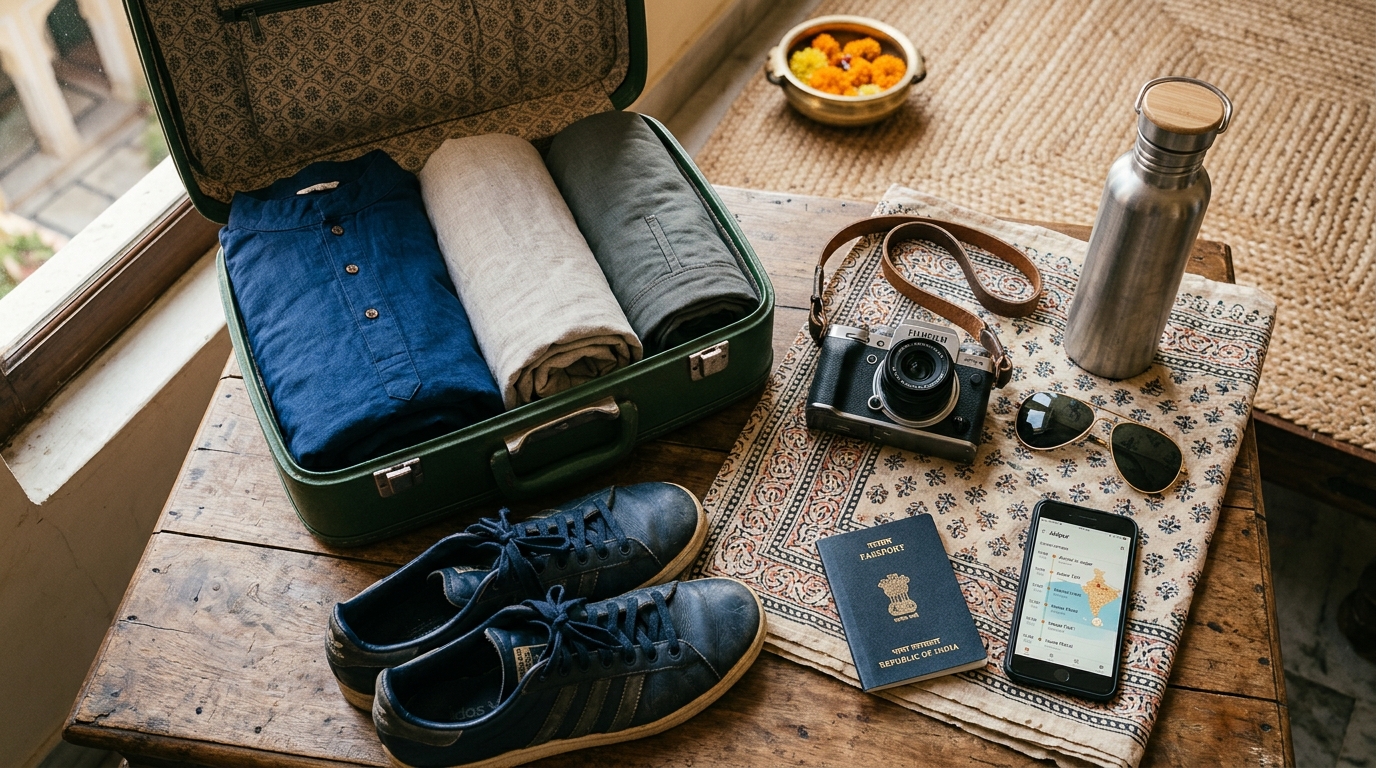
Packing Electronics for Asia: Voltage, Plugs & Charger Rules
Most travel blogs treat voltage like a boring checkbox — "bring an adapter, you're done." The reality is far messier for Indians traveling in Asia. Your 220V appliances, your phone charger, and your hair dryer will not work in 110V countries without a proper converter, an adapter alone won't save you, and the "universal" multi-region chargers sold at Mumbai airports often fail in the countries you actually visit.
Understanding voltage, plug types, and which chargers work where will save you ₹2,000–₹5,000 in damaged devices and emergency purchases abroad. This guide breaks down what you really need to pack.
1. Why Voltage Matters — and Which Countries Use What
India runs on 220–240V, 50Hz electricity. That's why your home appliances work. Most of Asia uses the same 220–240V standard — Thailand, Vietnam, Indonesia, Malaysia, and the Philippines all run 220V. Japan and North Korea, however, use 100V, 50/60Hz. Taiwan uses 110V, 60Hz. The USA and Canada use 110–120V, 60Hz.
The critical rule: plug-only adapters don't convert voltage. They just reshape the prongs. If you plug a 220V hair dryer into a 110V outlet using an adapter, you will destroy it (or worse, start a fire). For any dual-voltage appliance, adapters are safe. For single-voltage devices, you need a step-down converter — a bulky, expensive box.
Here's what you actually need to know:
- 220V countries (safe for Indian appliances with just an adapter): Thailand, Vietnam, Cambodia, Laos, Indonesia, Malaysia, Singapore, Philippines, Myanmar, Bangladesh, Nepal, Sri Lanka, Bhutan.
- 110V countries (need a converter OR dual-voltage charger): Japan, South Korea, Taiwan, USA, Canada.
- Mixed countries (check before you go): China uses 220V in most cities but 110V in some older buildings; Hong Kong uses 220V.
Your phone charger is already dual-voltage (check the label — it says "Input: 100–240V"). Your laptop charger is dual-voltage. Your hair dryer, probably not. Most travel-specific electronics (portable fans, curling irons sold as "travel" gear) claim to be dual-voltage but often aren't.
| Country | Voltage (V) | Frequency (Hz) | Adapter Type | Converter Needed? |
|---|---|---|---|---|
| India, Thailand, Vietnam | 220–240 | 50 | Not needed | No |
| Japan, Taiwan, South Korea | 100–110 | 60 | Type A | Yes (for non-dual-voltage) |
| USA, Canada | 110–120 | 60 | Type A/B | Yes (for non-dual-voltage) |
| China | 220 (mostly) | 50 | Type A/C/I | No (for most trips) |
2. Outlet Types in Asia — What You Actually See in Your Hotel Room
India uses Type D outlets (three round prongs in a triangular layout, rarely seen elsewhere). You almost certainly need adapters in Asia, even in 220V countries, because they use different plug types.
The plugs you'll encounter across Asia:
- Type A (USA-style, two flat prongs): Japan, South Korea, Taiwan, Thailand, Philippines, Cambodia, Laos.
- Type B (USA-style with round grounding pin): Less common, found in USA/Canada.
- Type C (European two round prongs): Vietnam, Singapore, Malaysia, Indonesia, parts of China.
- Type I (Australian, two angled flat prongs + grounding): China, sometimes in modern hotels.
Most Asian hotels (3-star and above) have at least one Type A or Type C outlet per room. Hostels, guesthouses, and older hotels may only have Type D (which accepts many plugs) or one specific type. Call ahead if you're staying in a small guesthouse.
For Indians, here's the practical rule:
- Buy a single Type A + Type C adapter pack (around ₹300–₹500 from Flipkart or Amazon before you leave).
- If you're visiting multiple countries in one trip, add a Type I adapter for China.
- Don't buy multi-region "world adapters" with rotating plugs — they're bulky, the rotating mechanism breaks, and they don't always grip your devices securely.
A compact adapter portfolio that actually works:
- One Type A adapter (slip-on, under 50g).
- One Type C adapter (slip-on, under 50g).
- Optional: one Type I adapter if traveling to China.
- Total cost: ₹400–₹700. Total weight: 150g.
3. Which Multi-Region Chargers Actually Work in Asia (Tested for Indian Travelers)
Your dual-voltage phone charger (100–240V) works everywhere with the right adapter. But USB-C power banks and "universal" fast chargers marketed as multi-region often have hidden voltage limits or incompatible plugs.
Here's what genuinely works across 220V and 110V Asia:
Option 1: Dual-voltage USB charger + adapters (safest, cheapest)
- Buy a Promate, Portronics, or Ambrane 65W USB-C charger (₹1,500–₹2,500) that says "Input: 100–240V" on the back.
- Add Type A and Type C adapters.
- This works in every country in Asia, zero risk.
Option 2: Travel-specific fast chargers designed for Asia
- Anker 65W GaN charger (dual USB-C + USB-A, Input: 100–240V, ₹3,500–₹4,500). Works everywhere. Heavy (200g) but industry-standard.
- Portronics Adapto 100 (60W, ₹2,200). Indian brand, rated for 100–240V, tested in 50 countries.
- These are worth the investment if you travel frequently.
Option 3: The risky "universal" multi-region charger (avoid)
- Cheap multi-region chargers (₹500–₹1,200) advertise "works in 100+ countries" but actually plug into only 3–4 outlet types and don't always provide stable voltage.
- Many are single-voltage (220V only, despite the label).
- You may damage a ₹30,000 phone to save ₹700.
Charger cost comparison for one trip to Thailand + Vietnam (21 days):
| Charger Type | Upfront Cost | Shipping Time | Voltage Risk | Outlet Type Certainty |
|---|---|---|---|---|
| Dual-voltage USB + adapters | ₹2,000 | 2–3 days | None | High (if you pick A+C) |
| Anker 65W GaN (premium) | ₹4,000 | 1–2 days | None | High |
| Cheap "universal" multi-region | ₹1,000 | 3–5 days | High | Moderate |
The cheapest safe option: use your existing phone charger + ₹500 adapter kit. You likely already own a 100–240V charger.
4. Voltage Converters — When You Actually Need One (Spoiler: Rarely)
A voltage converter steps down 220V to 110V (or vice versa). They weigh 500g–1kg, cost ₹3,000–₹8,000, and get hot. You only need one if you're traveling to Japan or the USA with a single-voltage device you can't replace.
When a converter is necessary:
- You have a 220V-only hair dryer or heating iron and refuse to buy a dual-voltage travel version.
- You're bringing an Indian-market pressure cooker or kitchen appliance to a 110V country for an extended stay.
- You've packed a ₹15,000 massage device that isn't dual-voltage.
When it's NOT necessary:
- For any phone, laptop, tablet, or modern camera charger (they're all dual-voltage).
- For travel hair dryers (most are dual-voltage; check the label first).
- For Southeast Asia (220V countries — no converter needed).
Practical rule: Don't pack a converter for a 1–2 week trip to Thailand or Vietnam. If you need hot-water appliances, buy a cheap dual-voltage travel kettle (₹600–₹1,200) in Thailand and leave it there.
If you absolutely must use a converter, buy it in India before you leave (₹3,500–₹5,000 from Amazon). Converters sold abroad cost 3–4× more and may not work with Indian appliances' frequency (50Hz).
5. Power Banks, Charging Cables, and Backup Power — What Actually Works
A power bank rated for 100–240V input is effectively useless — they don't have wall outlets to plug into. What matters is the output voltage, which is always standardized at 5V for USB. Every power bank on Earth outputs 5V. So a ₹1,500 power bank bought in India works identically in Thailand, Japan, or the USA.
Power bank strategy for Asian trips:
- Bring a 20,000mAh–30,000mAh capacity power bank (fits in your carry-on).
- Make sure it has USB-C and USB-A outputs (most modern ones do).
- Total weight: 300g. Cost: ₹1,500–₹3,000.
- Fully charge it before you leave India. It'll give you 1–2 full phone charges, enough for airport delays or day trips.
For longer trips (14+ days), also consider:
- A compact dual-USB charger (the brick, not the bank). Charges two devices simultaneously from a wall outlet. Weight: 150g. Cost: ₹800–₹1,500.
- USB-C cable (buy a spare in India — cables in Asia are often counterfeit). Cost: ₹300–₹500.
One common mistake: assuming every USB charger in Asia is safe. Counterfeit and substandard chargers are rampant in Bangkok, Ho Chi Minh City, and Manila. Don't buy electronics from street markets. Use hotel gift shops or established retail chains (7-Eleven, FamilyMart, Boots).
6. Packing List — Exactly What to Bring (And What to Leave)
You don't need a converter for most of Asia. Here's the actual packing list for a trip to Southeast Asia:
Must pack (weight: ~200g, cost: ₹500–₹800):
- One Type A adapter (slip-on, 20g).
- One Type C adapter (slip-on, 20g).
- One USB-C charging cable (30g, ₹300–₹500).
- Your existing phone charger (already dual-voltage, 50g).
Should pack (weight: ~300g, cost: ₹1,500–₹2,500):
- A 20,000mAh USB-C power bank.
- Optional: a compact dual-USB charger block if you're traveling with a partner or staying 14+ days.
Don't pack (heavy, unnecessary):
- Voltage converter (you don't need it for Southeast Asia).
- "Universal" multi-region charger (your existing charger is already universal if it says 100–240V).
- More than two adapters (you'll only use two plug types per trip).
Before you leave, check the voltage label on every device's charger. If it says "Input: 100–240V", it's safe everywhere. If it doesn't list input voltage or says "220V only", don't assume — look it up or replace it with a dual-voltage version.
Frequently Asked Questions
Is my iPhone charger actually dual-voltage?
Yes, if it's an original Apple charger (the small USB-C brick made after 2018). It clearly states "Input: 100–240V" on the back. Third-party chargers vary — check the label. If you're unsure, use your phone's cable + a reputable power bank in Asia instead.
Do I need different adapters for every Southeast Asian country?
No. You need Type A and Type C. Type A is used in Thailand, Cambodia, Laos, Philippines, and South Korea. Type C is used in Vietnam, Singapore, Malaysia, and Indonesia. One trip to these countries requires just two adapters. China, if you go, is Type A, C, and I. Japan is Type A only.
Can I use a 220V device in a 110V country with just an adapter?
No — absolutely not. An adapter changes plug shape only, not voltage. Plugging a 220V hair dryer into a 110V outlet will destroy it or cause a fire. You must use a step-down converter, which is bulky and expensive. For travel, buy a dual-voltage device instead.
How much will it cost me if I buy adapters at the airport in Bangkok or Singapore instead of India?
₹1,200–₹2,000 for a single adapter (vs. ₹250–₹300 in India). Airport shops in Asia mark up electronics 5–8×. Buy in India or online (Flipkart, Amazon deliver to you before departure). If you arrive and forgot, 7-Eleven and hotel gift shops are cheaper than airport shops.
My old charger doesn't list input voltage — how do I check if it's dual-voltage?
The label is usually on the brick (the box part you plug into the wall). Look for "Input" or "AC". If it says "100–240V 50/60Hz", it's dual-voltage and safe for any country. If it says "220V only" or "50Hz only", it won't work outside India. When in doubt, use Visa wizard for Indians to check your destination's standards, or buy a new charger in India for ₹1,500–₹2,500.
Plan Your Packing (And Your Trip) With Confidence
Voltage panic isn't necessary. Ninety percent of Indians traveling in Asia need only two cheap adapters and trust their existing phone charger. The real cost isn't in adapters — it's in replacing a ₹30,000 phone or laptop because you plugged it into the wrong outlet.
Test your devices before you leave India. Check labels. Buy Type A and Type C adapters on Amazon (delivered within 48 hours). For everything else, your phone charger and a power bank handle you.
Ready to finalize your Asia trip without the electronics stress? Generate your free AI itinerary →