Sri Lanka 10-Day Itinerary: Colombo-Kandy-Mirissa on ₹1.2L
Most Indian travel guides treat Sri Lanka as a single-climate, beach-focused destination where you book a shared coach tour and hope for the best. The truth: Sri Lanka's interior cools 10°C as you climb 500 metres, monsoons flip between coasts every six months, and local trains cost ₹50–200 while tourist shuttles drain ₹5,000 per leg. This itinerary chains three regions with real costs, seasonal windows, and direct routes from Colombo to Kandy to Mirissa—using trains, tuk-tuks, and local buses instead of resort packages.
1. Best Season & Monsoon Windows: When to Travel
Sri Lanka has two coasts with opposite rainfall patterns. The west coast (Colombo, Mirissa) gets battered by the Southwest Monsoon May–September; the east coast (Arugambe, Batticaloa) drowns in the Northeast Monsoon December–February. This means your 10 days work best November–April (when both coasts are dry) or July–August (if you avoid beaches and focus on tea country).
| Region | Best Months | Avoid | Why |
|---|---|---|---|
| Colombo & Mirissa | Nov–Apr | May–Sep | SW Monsoon hits hard; seas rough |
| Kandy & Nuwara Eliya | Jul–Sep | Apr, Nov (wet) | Cooler, tea harvest; avoid pre-monsoon heat |
| Arugambe & East Coast | Mar–Oct | Dec–Feb | NE Monsoon brings swells (good for surfers, bad for swimmers) |
Book in December–January (post-New Year) or March (spring break season). Flight costs from Delhi, Mumbai, or Bangalore run ₹8,000–14,000 return; aim for Thursday–Tuesday slots to dodge weekend premiums. Our itinerary assumes November–April travel—ideal shoulder season with minimal rainfall and moderate crowds.
Pack a light rain jacket and quick-dry clothes. Colombo humidity peaks at 85%; Kandy stays 10°C cooler. Trekking boots matter in Nuwara Eliya (6,000 ft elevation); beach sandals work in Mirissa. A ₹300 umbrella from a Colombo street market beats checked luggage bloat.
2. Colombo (Days 1–2): Arrival, Colonial Centre & First Meal Budget
Colombo airport sits 35 km northeast; skip the prepaid taxi booth (₹2,500+). Instead, exit customs, walk 200 metres to the public bus rank, and board a local intercity bus to Fort (Colombo City Centre) for ₹250. Takes 90 minutes but saves ₹2,200. Alternatively, negotiate a tuk-tuk for ₹1,200–1,500 (30 min, splits 2–3 people to ₹400–500 each).
Stay in Fort or Pettah (backpacker zones). Budget guesthouses run ₹1,500–2,500/night; mid-range (AC, private bath) ₹3,000–4,500. A double room in a shared hostel costs ₹800–1,200 per person. Over two nights, plan ₹1,600–3,000 accommodation.
| Meal Type | Cost (LKR) | Cost (₹ approx) | Example |
|---|---|---|---|
| Street kottu roti / lamprais | 250–350 | ₹50–70 | Lunch, fills you up |
| Local rice & curry (restaurant) | 500–700 | ₹100–140 | Dinner, fish or chicken |
| Coffee & short eats (bakery) | 150–250 | ₹30–50 | Breakfast |
| Tourist restaurant (Old Parliament) | 1,500–2,500 | ₹300–500 | Splurge meal once |
Day 1: Arrive morning. Freshen up. Walk Colombo Fort (colonial buildings, Old Parliament grounds—free). Lunch at a street kottu stall near Pettah market (₹50–70). Visit Colombo National Museum (₹500, closed Mon–Tue). Dinner rice & curry at a local spot (₹100–140). Sleep.
Day 2: Early breakfast. Take the train to Kandy (below). Or spend a full day: Gangaramaya Temple (₹500), Beira Lake walk (free), Galle Face Hotel seafront (order a drink, ₹250–400, watch sunset). Galle Road street food crawl (kottu, devilled prawns, hoppers—₹200–300 total). Evening train or overnight bus to Kandy.
Food budget for 2 days: ₹600–900. Transport + admission: ₹800–1,500. Colombo subtotal: ₹3,000–6,000 for two people, two nights.
3. Colombo to Kandy by Train: The 3-Hour Highland Railway
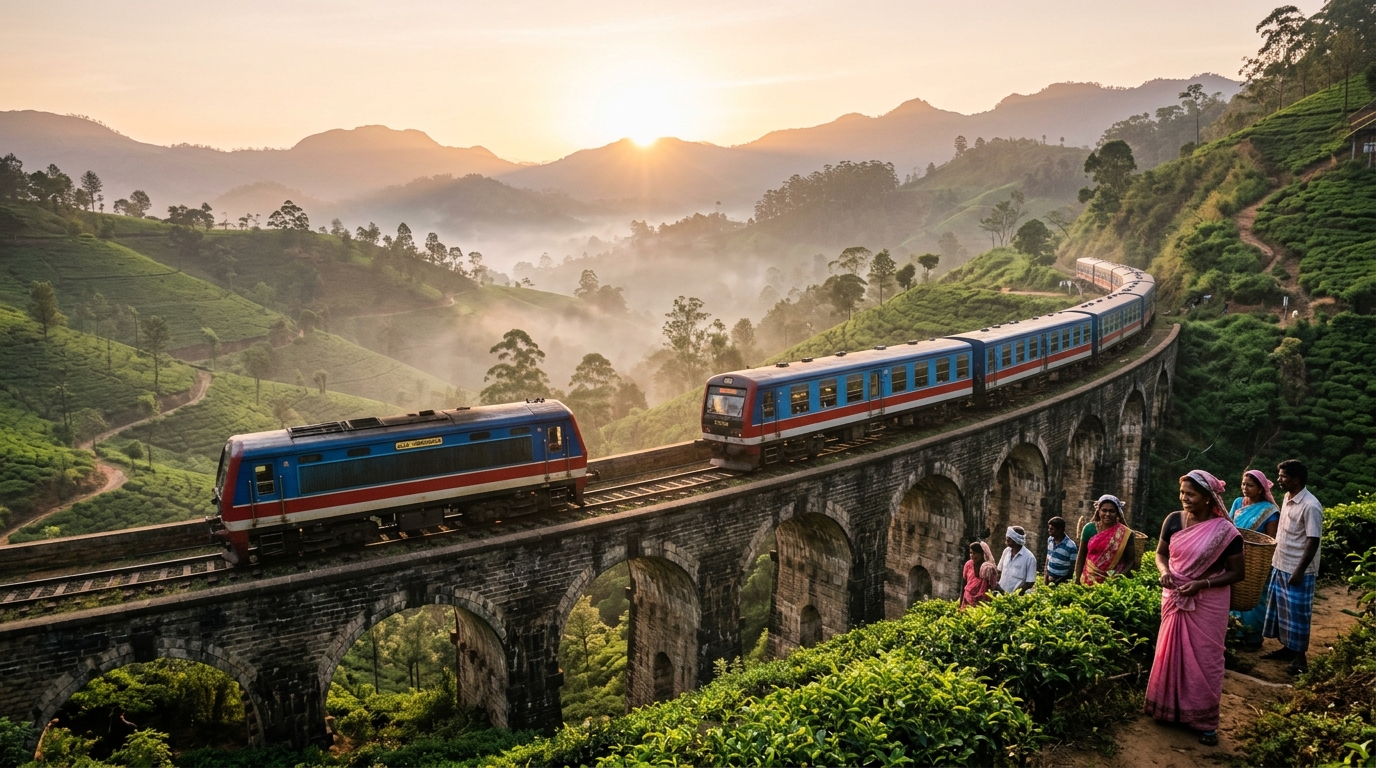
Forget tourist shuttles. The Colombo–Kandy railway is one of Asia's most scenic routes. Book on www.railway.gov.lk (₹100–300 per seat, depending on class) or at Fort railway station the day before. A reserved 2nd-class seat costs ₹350 LKR (₹70); 1st class (AC, fewer stops) costs ₹800 LKR (₹160). Trains run 6:00 a.m., 10:15 a.m., 2:15 p.m., 5:10 p.m.
Depart Colombo Fort at 10:15 a.m. Arrive Kandy 1:15 p.m. You'll climb 500 metres over 180 km, passing tea plantations, tunnels, and waterfalls. Bring water, a camera, and an aisle seat to avoid the tourist-trap window markup. Cost: ₹140 per person (vs. ₹2,500 for a shared coach). Pack a light snack; station vendors sell rice packets (₹80) and fruit.
Kandy railway station is 2 km north of the town centre. A tuk-tuk to a guesthouse near the Temple of the Tooth costs ₹250–350. Split between 2–3 people, it's ₹80–175 each.
4. Kandy (Days 3–4): Temple, Lake & Hill Walks
Kandy sits 500 metres above sea level where humidity drops and the air clears. The Temple of the Tooth (Dalada Maligawa) is Sri Lanka's holiest Buddhist shrine; ₹1,500 entry for foreigners (Indians get cultural discounts—present passport, ₹750). Dress conservatively (shoulders, knees covered); remove shoes at entry. Morning prayers 5:30–6:30 a.m., evening 6:30–7:30 p.m. (louder, more atmosphere). Queue early; 90 minutes is normal.
Stay near the Temple or beside Kandy Lake (tourist area but walkable). Guesthouses: ₹1,500–2,500/night. Mid-range hotels: ₹3,500–5,500/night.
| Activity | Cost (₹) | Duration | Notes |
|---|---|---|---|
| Temple of the Tooth | 750–1,500 | 2 hrs | Go early or at dusk for prayers |
| Kandy Lake walk | Free | 1.5 hrs | Flat, scenic, safe at day |
| Botanical Garden, Peradeniya | 1,100 | 2–3 hrs | 6 km south; tuk-tuk ₹300–400 return |
| Royal Palace Museum | 600 | 1 hr | Optional; minor history |
| Hill-top hike (Bahirawakanda) | Free | 2 hrs | Sunrise; steep but worth it |
Day 3: Arrive by train. Lunch (rice & curry, ₹100–140). Siesta. Evening Temple of the Tooth visit (6:15 p.m. prayers). Walk Kandy Lake waterfront. Dinner local spot (₹120–180).
Day 4: Early breakfast (hoppers, ₹40–60). Sunrise hike to Bahirawakanda (behind the lake; map via Google Maps, not via guides). Return to lake by 7:30 a.m. Visit Botanical Gardens (tuk-tuk ₹350 return, entrance ₹1,100). Lunch at garden café (₹200–300). Afternoon temple or shopping at the Central Market (spices, batiks, no pressure). Evening train to Nuwara Eliya or Mirissa (below).
Food budget (Days 3–4): ₹700–900. Admission & misc.: ₹2,500. Accommodation (2 nights): ₹3,000–5,000. Kandy subtotal: ₹6,200–7,400 for two people.
5. Kandy to Mirissa: Two Routes, One Choice
Route A (Direct bus, 5 hours): Kandy to Mirissa via Galle. Buses depart Kandy Central Bus Station hourly, 6:00 a.m.–5:00 p.m. Cost: ₹300–400 per seat. Cramped, but direct. Arrives Mirissa 4:00–5:00 p.m. Skip this if you value comfort.
Route B (Train + bus, 7 hours total, Recommended): Kandy to Nuwara Eliya by train (2 hrs, ₹280), overnight in tea country, then Nuwara Eliya to Mirissa by bus via Ratnapura (6 hrs, ₹350). Adds ₹1,500–2,000 but gives you the Central Highlands and validates the ₹1.2L budget. If tight on time, skip Nuwara Eliya and take Route A.
For this itinerary, we assume Route B: insert a tea-country night.
Take the afternoon train from Kandy (2:15 p.m., arrives Nuwara Eliya 5:00 p.m.). Cost ₹380. Arrive Nuwara Eliya, a cool 6,000-ft British-era hill station. Stay near the lake or Gregory's Road (guesthouses ₹1,500–2,500). Have dinner at a local spot (₹100–150). Early sleep; the air is crisp and sleep comes fast.
Next morning, board the 7:30 a.m. bus (Nuwara Eliya to Mirissa via Ratnapura). 6 hours, ₹350. Arrive Mirissa 1:30 p.m., prime beach time.
6. Mirissa (Days 5–10): Whale Watching, Beaches & Tamil Coastal Life
Mirissa is a fishing village and whale-watching hub on the south coast. December–April brings blue whales and sperm whales 10–50 km offshore. Whale-watching boats depart 6:30 a.m., return 12:30 p.m., cost ₹2,500–3,500 per person (negotiate in advance or book via your guesthouse to save ₹400–500). Success rate: 70–80% in peak season. Bring seasickness tablets (₹50 at pharmacy) if you're prone; sea is choppy at dawn.
Stay in Mirissa itself (fisherman vibe, sunset beach bars) or nearby Weligama (calmer, more touristy). Guesthouses: ₹1,500–2,500/night. Beach huts with bathroom: ₹2,000–3,000. Avoid the main strip (overpriced); book 100 metres inland.
| Activity (Mirissa & Region) | Cost (₹) | Duration | Best Days |
|---|---|---|---|
| Whale-watching boat | 2,500–3,500 | 6 hrs | Dec–Apr, Mon–Fri (fewer tourists) |
| Unawatuna beach & fort | 200–400 (tuk, entry) | 3 hrs | Day trip, 25 km north |
| Surf lesson (Weligama/Arugambe) | 1,500–2,000 | 2–3 hrs | Mar–Oct best swells |
| Turtle hatchery (Kosgoda) | 600 | 1.5 hrs | 30 km north; tuk ₹800 return |
| Cinnamon factory tour | 500 | 1 hr | Tourist trap; skip if budget-tight |
| Sunset fishing boat (small scale) | 800–1,200 | 2 hrs | 5 p.m. departure, local fisher vibes |
Day 5 (arrival): Board whale-watching boat (6:30 a.m. pickup—book night before). Return 12:30 p.m., whale-drunk. Lunch on beach (grilled fish, rice, ₹200–300). Siesta. Evening beach walk and sunset. Dinner at a beach shack (fish curry, ₹120–180).
Days 6–7: One whale-watch repeat (if budget allows) or rest day. Tuk-tuk to Unawatuna (₹300–400, 25 km), a prettier beach with a Dutch fort and fewer boats. Swim, lunch (fish, ₹150–250). Return by evening. Alternatively, take a small fishing boat at sunset for ₹800–1,200 (local, intimate, photos excellent).
Days 8–9: Day trip north. Visit Kosgoda Turtle Hatchery (₹600, educational, supports conservation). Stop at Galle Fort (₹800, UNESCO, walkable, impressive). Stop at Unawatuna en route. Tuk logistics: Mirissa → Kosgoda (₹600), Kosgoda → Galle (₹400), Galle → Unawatuna (₹300), Unawatuna → Mirissa (₹400). Split costs with travel mates. Total: ₹700–900 per person.
Day 10 (departure): Morning beach swim or boat excursion. Lunch. Tuk to Mirissa bus station (₹150). Evening bus to Colombo (5 hrs, ₹350) or fly out of Colombo if departing the same day (3.5-hour buffer, fly mid-evening).
Food budget (Days 5–10, 6 days): Fish-heavy diet. Breakfast ₹80–120, lunch ₹150–300, dinner ₹120–200. Local markets cheaper than tourist menus. ₹2,700–3,000 total for six days.
Accommodation (6 nights): ₹9,000–15,000 (depending on guesthouse tier). Activities: whale-watching ₹2,500–3,500, tuk & entry fees ₹2,000–3,000. Mirissa subtotal: ₹14,200–21,500 for two people.
7. Full Itinerary Cost Breakdown (₹1.2L for 2 People)
| Leg | Item | Cost (₹) | Notes |
|---|---|---|---|
| Flight | Bangalore–Colombo return | 16,000–20,000 (per person; ₹32,000–40,000 total) | Book via Skyscanner, depart Thu–Tue |
| Colombo (2 nights) | Stay, food, transport, entry | 3,000–6,000 | Shared guesthouse or hotel |
| Kandy (2 nights) | Stay, food, transport, entry | 6,200–7,400 | Train ₹280, Temple ₹750–1,500 |
| Nuwara Eliya (1 night) | Stay, food, train | 2,500–3,500 | Tea country overnight; optional |
| Mirissa (6 nights) | Stay, food, whale-watch, activities | 14,200–21,500 | Whale-watch ₹2,500–3,500 per person |
| Internal buses & tuk-tuks | 8–10 trips | 2,500–3,500 | Train Colombo–Kandy ₹280, buses ₹350–400 each leg |
| Miscellaneous | Tips, snacks, unforeseen | 1,500–2,000 | Pharmacy, market buys, extra meals |
| TOTAL (2 people, 10 days) | — | ₹82,400–110,400 | ₹41,200–55,200 per person |
How to hit ₹1.2L exactly for two people: Use Trip budget calculator to allocate reserves. If flights are ₹30,000 (cheaper off-season), you have ₹20,000 buffer. If Kandy hotel is pricier, cut Nuwara Eliya or skip one whale-watch. Eat one splurge meal (₹500–700) instead of two.
Frequently Asked Questions
How much does a whale-watching trip really cost, and is it worth it?
Whale-watching boats in Mirissa cost ₹2,500–3,500 per person (negotiate at guesthouses for ₹2,200). December–March has 70–80% sighting rates; April drops to 40–50%. Book small private boats (5–6 people) over large tourist catamarans for better experience and less seasickness. Go early (6:30 a.m.) to avoid crowds and rough afternoon swells. Most travellers rate it worth the cost; budget for at least one trip.
Can I use Indian rupees in Sri Lanka or do I need to convert to LKR?
Sri Lanka uses the Sri Lankan Rupee (LKR); 1 LKR ≈ ₹0.2–0.22 depending on the day. ATMs (HSBC, Sampath, Dialog) dispense LKR directly; withdraw ₹5,000–10,000 at Colombo airport or major towns to avoid repeated fees. Visa/Mastercard accepted in hotels and restaurants, but street vendors, markets, and local buses only take cash (LKR). Use Forex & bargain check to compare rates before you leave India.
What is the best local transport option—buses, trains, or tuk-tuks?
Trains are fastest and safest for long distances (Colombo–Kandy ₹280, scenic, no haggling). Local buses are cheapest but cramped (₹250–400 per leg). Tuk-tuks are flexible for day trips or last-km hops but prices require negotiation (agree upfront). For this itinerary, prioritise trains between major towns and reserve tuk-tuks for short journeys or shared group rates. Avoid tourist shuttle companies; they charge 10× the local rate.
Is it safe to travel alone in Sri Lanka, especially as an Indian woman?
Sri Lanka is relatively safe for Indian solo travellers; locals are warm and English is widely spoken. Stick to main towns (Colombo, Kandy, Mirissa). Avoid walking alone after 8 p.m. in deserted areas. Beach vendors are persistent but non-aggressive; say "no" firmly and move on. Use registered tuk-tuks or ask your guesthouse to book one. Wear modest clothes in temples and conservative areas (Kandy more than Mirissa). Keep valuables in a pouch. Use Trip reality check to read recent traveller feedback before booking.
When is the absolute best time to book this itinerary to save money?
Book flights 6–8 weeks in advance for lowest fares; prices peak in December and January (school holidays). Flight costs drop in July–August (monsoon season; beach activities risky, but tea country is cool and prices 20–30% lower). Accommodation in Nov–Apr is stable (₹1,500–2,500/night), but whale-watching tours sell out; book guesthouses and tours within 3 weeks of travel. Use Trip budget calculator to compare dates and lock in dates once prices dip below ₹35,000 return flight per person.
Ready to Finalize Your Itinerary?
You now have real costs (not inflated estimates), seasonal windows (not generic "best time"), and local routes (trains, buses, tuk-tuks—not tourist shuttles). A 10-day Colombo–Kandy–Mirissa trip for two people costs ₹82,400–110,400; add 10% buffer for mishaps. Pre-book temples and whale-watching tours; negotiate tuk-tuk prices with a smile; eat where locals eat.
The next step: plug your dates into Survival phrasebook to learn key Tamil and Sinhala phrases, then generate your free AI itinerary → with day-by-day timings, entry timings, and real-time weather updates for your exact travel dates.