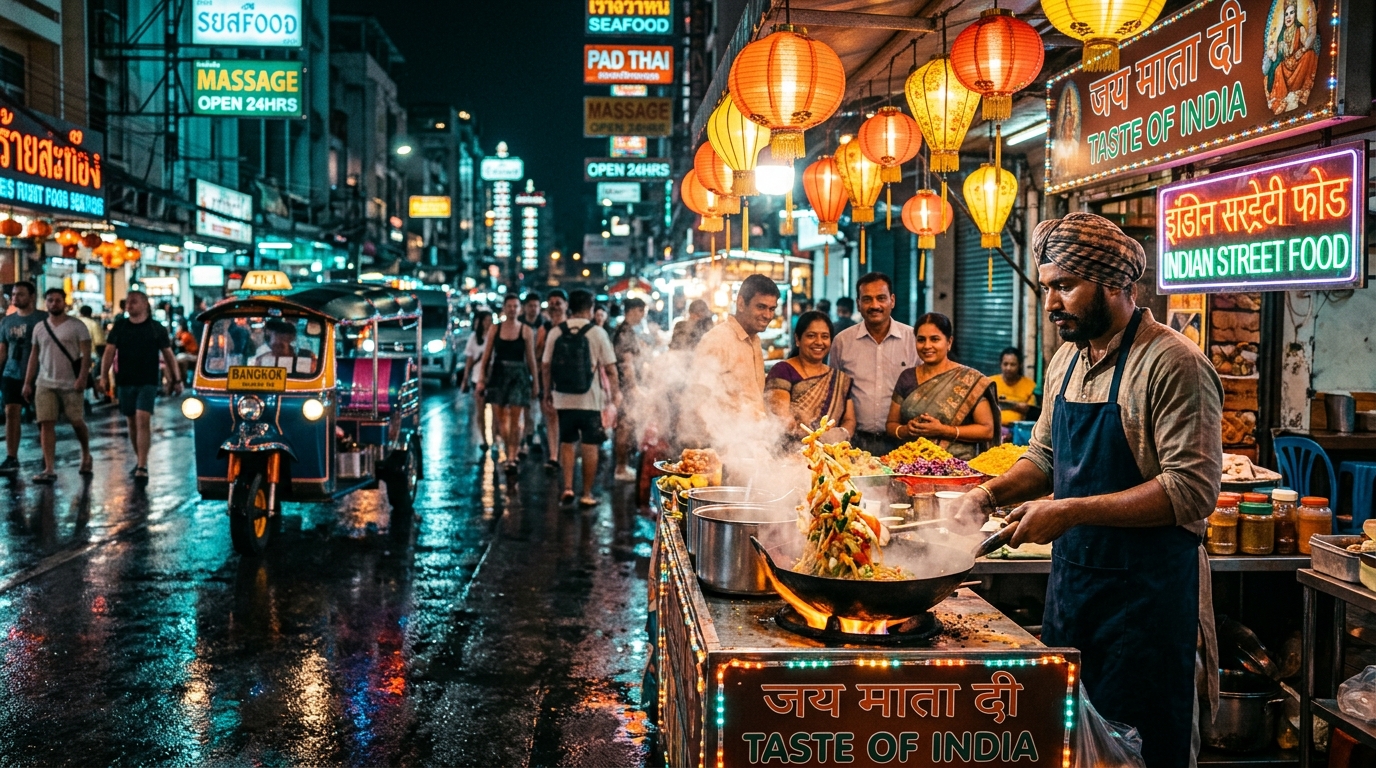
Thailand Visa for Indians: Tourist vs. E-Visa Options
Most travel blogs treat Thailand visas as an afterthought—slap on a 30-day exempt and move on. But for Indian passport holders, the choice between a physical tourist visa, an e-visa, and visa-free entry actually has real cost and timing consequences that can add or subtract ₹2,000–₹5,000 from your trip budget. We'll break down every option so you book the right one, not just the easiest one.
1. The Three Visa Paths: What Each Actually Gives You
Thailand offers Indian citizens three legal entry routes. Most travelers don't realize all three exist—or that the wrong choice can mean a rushed embassy visit or an unnecessary visa run.
Visa-free arrival (30 days, no document needed) is the path most Indians take. You land, get stamped at the counter, done. No fees, no paperwork. But you cannot extend it beyond 30 days without leaving Thailand.
The 60-day tourist visa (issued by Thai embassy) costs ₹2,150–₹3,500 depending on your city and comes in two sub-types: single-entry (valid 90 days from issue, one arrival) and multiple-entry (valid one year, as many arrivals as you want). You can extend it by another 30 days in-country for ₹1,900 at any Thai immigration office.
The e-visa (online, same-day approval) costs ₹3,000–₹3,500, bypasses the embassy queue, and gives you 60 days. Here's the critical difference: the e-visa cannot be extended inside Thailand. Once those 60 days end, you're done.
| Visa Type | Cost (₹) | Duration | Extendable? | Processing | Embassy? |
|---|---|---|---|---|---|
| Visa-free | 0 | 30 days | No | Instant | No |
| 60-day Tourist (single) | 2,150–3,500 | 60 days | Yes (+30 days for ₹1,900) | 3–5 business days | Yes |
| 60-day Tourist (multiple) | 4,500–6,000 | 60 days (valid 1 year) | Yes (+30 days for ₹1,900) | 3–5 business days | Yes |
| E-visa | 3,000–3,500 | 60 days | No | 1–2 days | No |
The multiple-entry tourist visa is the outlier. It costs more upfront but lets you leave and re-enter Thailand without a new visa for a full year. If you're planning a multi-country Southeast Asia trip (Thailand–Cambodia–Vietnam–back to Thailand), this is the one.
2. Cost Breakdown: Don't Forget the Hidden Fees
The visa price is only half the story. Processing, courier, and proof-of-funds documents add up fast.
Tourist visa via embassy. Print the TM.86 form, prepare passport photos (4 required—₹200–₹400), book an appointment (some cities now use an online system), and visit in person. You'll also need proof of funds (₹24,000 bank statement minimum, though they rarely check) and confirmed return ticket. The visa itself is ₹2,150–₹3,500, but courier fees (if using a visa agency) run another ₹1,000–₹2,000. If you're in a city without a Thai embassy (Jaipur, Lucknow, Pune), you use an accredited agent, which adds ₹800–₹1,500 and 5–7 extra days.
E-visa online. Go to thaievisa.go.th. No photos, no appointment, no embassy visit. Cost: ₹3,000–₹3,500 (paid via credit card, 1–1.5% processing fee included in most providers' markup). Print the approval letter, nothing else. Processing takes 1–2 days. The catch: you need a scanned passport page, a digital photo (4×6 cm, specific background), and you submit it once—no edits allowed. One typo and you pay again.
Proof of funds reality check. Thai immigration technically requires either a letter from your bank or ₹24,000 in hand. In practice, they check this for 5% of tourists. But if you're flagged (young, traveling solo, cash-heavy), they will ask. Use our Trip budget calculator to document your trip spend upfront.
Here's the honest comparison:
- Tourist visa for ₹2,150 (single-entry) + photos + return ticket: Total real cost ₹2,700–₹3,200 if you live near an embassy; ₹4,000–₹5,000 if you use an agent.
- E-visa for ₹3,000 + credit card fee: Total real cost ₹3,100–₹3,300, zero embassy time.
- Visa-free for ₹0: Total real cost ₹0, but limits you to 30 days and no extension.
3. Processing Time: When to Apply (And Why Rushing Costs More)
Thailand works on human time, not startup time. Missing your embassy appointment means rescheduling in 2–3 weeks.
Tourist visa. If you apply at an embassy in your city (Delhi, Mumbai, Chennai, Bangalore, Hyderabad have them), you'll get an appointment 3–7 days out. Then processing takes 3–5 business days after submission. Total: 8–14 days. If you use a visa agency, they take 2–3 days plus internal processing = 7–10 days, but cost ₹1,500–₹2,500 extra. If your city doesn't have an embassy (Chandigarh, Jaipur, Ludhiana), an accredited agent is mandatory, adding 3–4 more days.
E-visa. Upload documents at 8 AM, approval by noon the next day. Worst case: 2 days. But the "rush" is psychological. Most people file 2–3 weeks before travel anyway. The real risk: a typo in your name or passport number requires a fresh application (and fresh fee). Indian passports have been rejected for "not matching the system" because applicants wrote "Amar" and their passport says "AMAR". Double-check everything.
Timing recommendation for Indian travelers. If you have your passport and a confirmed flight, apply for the tourist visa as soon as your flight is bookable (typically 2–3 months before). If you're more than 3 months out, wait—visas expire if not used within 90 days. For e-visas, apply 10–14 days before departure to avoid panic charges.
A real scenario: You book a flight for January 15. On December 1, you apply for tourist visa. Embassy gives you an appointment December 10. You visit, visa approved by December 15. You're safe. Contrast: You book January 15, realize on January 5 you need a visa, rush to an agent, pay ₹2,500 extra for 24-hour processing. False urgency = ₹2,500 in your pocket.
4. Extension Logic: 30 Days More, But Only If You Chose Right
This is where most tourists stumble. You arrive on e-visa thinking you can extend. You can't. You're now scrambling on day 55.
Tourist visa holders can extend their visa inside Thailand for ₹1,900 at any regional immigration office. Bring your passport, TM.7 form (free, available at immigration), one passport photo, and cash. Processing is instant (same day, usually within 2 hours). This gives you 30 more days, no questions asked. The extension is tied to your original visa—so if you arrived on a single-entry tourist visa, you can stay 60 + 30 = 90 days total.
E-visa holders cannot extend. If you booked wrong and need 90 days, your only legal option is to leave Thailand, then re-enter on a new e-visa or visa-free. Most do a border run to Cambodia or Malaysia for 1–2 days. Cost: ₹8,000–₹15,000 in flights, plus accommodation and hassle.
Visa-free arrivals can theoretically extend, but it's messy. You can get a "Permit to Stay" for ₹1,900, which extends by 30 days. But this requires proof of onward flight and accommodation. Most immigration officers will ask why you didn't apply for a tourist visa in the first place. It's legal, but treated like a loophole.
The right move for 90+ days: Book the 60-day tourist visa before you leave India. Don't trust you'll extend. Extend costs only ₹1,900, but requires in-person paperwork. If you're in a remote province (Chiang Rai, Krabi), expect 3–4 hours at immigration. Plan for day 55 extension, not day 59.
5. Which Visa Type Saves You Time and Money
The decision tree is simple once you know your stay length and where you live.
If you're staying 30 days or less: Visa-free entry wins. ₹0 cost, instant approval. No thinking required.
If you're staying 31–60 days: Get the e-visa if you're confident you're leaving on day 60. Apply 2 weeks before, pay ₹3,000–₹3,500, and walk straight past the visa queue at the airport. Total time: 10 minutes at the counter. Total cost: ₹3,200. If you might stay longer, get the tourist visa instead—it costs ₹500–₹1,000 more but gives you options.
If you're staying 61–90 days: Tourist visa + extension is mandatory. Book it 4–6 weeks ahead, pay ₹2,150 at the embassy (+ ₹500–₹1,500 if using an agent), then extend in-country for ₹1,900 on day 55. Total cost: ₹4,050–₹5,550, depending on agent. Total time: 1 visit to embassy + 3 hours at immigration counter.
If you're doing a multi-country Southeast Asia loop and coming back to Thailand: Multiple-entry tourist visa. Yes, it's ₹4,500–₹6,000 upfront. But it's valid for 12 months, so you can leave and re-enter Thailand 3–4 times without new paperwork. Compare that to four separate single-entry visas = ₹8,600–₹14,000. The multiple-entry wins for ₹2,500–₹8,000.
Check our Visa wizard for Indians to match your itinerary to the exact visa type.
Table: Visa Type by Traveler Profile
| Profile | Recommended Visa | Why | Cost (₹) |
|---|---|---|---|
| 30 days, first time | Visa-free | No paperwork, zero cost | 0 |
| 31–60 days, fixed | E-visa | Fastest, no embassy queue | 3,000–3,500 |
| 31–60 days, flexible | 60-day tourist | Can extend if needed | 2,150–3,500 |
| 61–90 days | 60-day tourist + extension | Tourist visa + ₹1,900 extension | 4,050–5,550 |
| Multi-country loop | 60-day multiple-entry | One year, unlimited re-entry | 4,500–6,000 |
6. Real Pitfalls: What Goes Wrong (And How to Avoid It)
Indian passport holders hit a few predictable snags that other travelers don't.
Passport validity cushion. Thai immigration requires your passport to be valid for at least 6 months from entry. But some agents and airlines are stricter—they want 6 months from your exit date. Check your passport validity now. If it expires in less than 8 months, renew it before applying for a visa. Your visa becomes invalid if your passport does.
Name mismatches on documents. Your passport says "AMAR KUMAR SINGH", your flight says "Amar Kumar Singh", your e-visa form says "Amar Singh". Inconsistency = rejected entry. Print your passport name exactly as it appears, character-by-character. Use our Survival phrasebook to verify pronunciation with Thai officials.
Return flight proof. Most visas don't require a return flight. But if immigration suspects you're trying to stay beyond your visa (age, travel history, luggage), they'll ask. Book a refundable or flexible return ticket before you visit an embassy. Cost: ₹1,000–₹3,000 for flexibility, worth it.
Credit card issues with e-visas. The official Thai e-visa portal (thaievisa.go.th) charges via payment gateway. Some Indian cards get flagged as international transactions, causing a failed charge. Use a debit card or try again 2 hours later. Do NOT use a third-party visa agency unless they have ₹0 markup—some charge ₹500–₹1,000 extra just to process the form for you.
Overstay accidentally. It's easy to lose track. Your visa says "permitted until 15 March" but you fly out on 16 March. Overstay for even one day = ₹500 fine per day, plus a stamp in your passport flagging you. Use a phone reminder on day 55 to check your exit date. Thai immigration will not remind you.
Frequently Asked Questions
How much does a Thailand tourist visa cost for Indians from Delhi?
The 60-day single-entry tourist visa costs ₹2,150 at the Royal Thai Embassy in Delhi. You'll also spend ₹200–₹400 on passport photos and ₹1,000–₹2,000 if you use a visa agency to avoid visiting in person. Total: ₹3,350–₹4,550. The e-visa costs ₹3,000–₹3,500 and skips the embassy line entirely.
Can I extend my Thailand e-visa for another 30 days if I stay longer?
No. The e-visa cannot be extended inside Thailand. If you need more than 60 days, book the 60-day tourist visa before you leave India instead. The tourist visa can be extended for ₹1,900 at any Thai immigration office. If you've already arrived on an e-visa and need to stay longer, your only option is to leave Thailand (border run to Cambodia or Malaysia) and re-enter on a new visa or visa-free.
What is the difference between a single-entry and multiple-entry tourist visa for Thailand?
A single-entry visa (₹2,150–₹3,500) lets you arrive once and stay up to 60 days. If you leave Thailand, you cannot re-enter on the same visa—you need a new one. A multiple-entry visa (₹4,500–₹6,000) is valid for 12 months and lets you leave and re-enter Thailand as many times as you want. Book multiple-entry if you're island-hopping to Cambodia or Vietnam and coming back to Thailand.
How long does it take to get a Thailand visa if I apply from Mumbai?
The Royal Thai Embassy in Mumbai processes tourist visas in 3–5 business days after you submit documents. Plan 1–2 days for an appointment, so total is 5–7 days door-to-door. If you use an accredited visa agency, expect 7–10 business days total. The e-visa approves in 1–2 days online, no embassy visit needed.
Can I enter Thailand on a visa-free 30-day stamp and then extend it to 60 days?
You can technically extend the visa-free entry by 30 days (for ₹1,900) to stay 60 days total, but most immigration officers treat it as a workaround. If you know you need 60 days, book the 60-day tourist visa before leaving India—it's simpler, costs only ₹500–₹1,000 more, and avoids the awkward conversation at immigration.
The visa you choose determines not just how long you stay, but whether you waste time at an embassy and whether you panic-extend at the last minute. Indian travelers have the advantage: all three visa paths are equally accessible to us (unlike tourists from some countries who have limited options). Don't default to visa-free or e-visa just because they're famous. Match your visa to your itinerary, book it 4–6 weeks early, and move on.
Get your exact stay length pinned down before you book flights. Then use our Trip reality check to validate your visa against your itinerary, accommodation, and budget. Generate your free AI itinerary →